

For ambitious couples strategizing their wedding budget, hosting 100 guests at a nice venue beats out a 200-guest fiesta at a budget spot—financially and experientially. A smaller guest list means you can streamline costs, splurge on quality where it counts, and still have a killer event that gets the job done. Remember, wedding planning is project management, not a Pinterest board. Stay organized, calculate your per-head cost, and pivot where necessary. Curious about timeline hacks and cost metrics?
The short answer (what most people should do)
Let’s cut to the chase: most couples should aim for a wedding that doesn’t leave them financially shell-shocked. If you’re juggling between a large cheap affair at a budget venue or a small nice event, consider the guest count venue tradeoff. A 200-guest wedding at a budget venue might sound like a steal, but the costs—$56,800 at $284 per person—can quickly spiral. Research from Columbia University consumer economics shows that wedding spending patterns are heavily influenced by guest count, often more so than the venue itself. Conversely, a 100-guest wedding at a nice venue, averaging $33,000, can be more manageable. In major metros like NYC, the costs can be significantly higher, with some weddings averaging around $65,000. Strategically streamline your guest list to hit that sweet spot of 116. This approach not only keeps costs in check but also guarantees you don’t sacrifice quality. Remember, fewer guests mean less stress and more room for curated coolness. Ready to pivot? Start by crafting your guest list now.
The real answer: what it depends on
What truly determines the right choice between a budget venue and a nice one? It boils down to the guest count and your venue decision. Here’s the reality:
- Cost per Guest: Averages hover around $284 per guest. More guests mean more dough, no surprise there. Research by the American Psychological Association suggests that the quality of relationships can also play a role in how couples approach wedding planning and budgeting.
- Venue Type: Nice venues cost more upfront but can be diluted over more guests. Budget venues keep fixed costs lower.
- Location Influence: Where you plant your flag matters. New York City weddings skyrocket costs; Utah, not so much. Location significantly affects overall wedding costs, with urban areas often having higher venue rental prices and vendor services.
- Fixed vs. Variable Costs: Fixed costs like photography stay put, but catering balloons with each extra invite.
Ultimately, balance ambition with strategic execution. Consider venue pros and cons and pivot accordingly. Ready to accelerate your planning? Time to dig into those spreadsheets.
Decision framework (choose the right move fast)
When it comes to nailing down the right wedding venue, strategic execution is your secret weapon. Look, decisions don’t have to be complicated. Use a break-even analysis to understand costs fast. Calculate like this:
| Scenario | Guest Count | Total Cost |
|---|---|---|
| Budget Venue | 200 | $58,500 |
| Nice Venue | 100 | $40,000 |
| Premium Add-Ons | 100 | Incremental |
If cutting guests saves less than the social fallout, keep the larger list. Tackle pesky hidden costs like gratuities and rentals upfront. Rapid decision rule: compare variable cost savings to guest value. Pivot with efficiency—use a simple spreadsheet to weigh options instantly. Execute the choice that aligns with your values and gets the job done. Ready to move? Let’s hustle! Remember, considering marriage psychology can help guide your choices so your partnership starts strong from day one.
Recommended timeline / checklist (so you don’t miss anything)
You’ve nailed the venue decision and are ready to keep the momentum going. Let’s execute a timeline that gets the job done without the stress. Here’s your streamlined checklist:
- 18+ Months Out: Insure that engagement ring and craft your wedding vision board. Define budget and priorities—non-negotiable. If you or your partner are considering a marriage-based green card, it’s smart to start gathering necessary documentation at this early stage.
- 12-10 Months Out: Finalize your guest list and send save-the-dates. Book the venue and build that wedding website. Lock it down early—availability is scarce.
- 6-4 Months Out: Finalize your menu and book those essential vendors like the DJ and floral designer. Apply for that marriage license—don’t procrastinate.
- 3-1 Months Out: Confirm all vendors with timelines. Compile RSVPs, create your seating chart, and submit final guest counts. Remember to provide the final guest count to the caterer and venue to ensure a smooth dining experience.
Reality Check: Stay flexible; things might pivot.
Examples (realistic scenarios)
When you’re racing against the clock with limited venue options, executing a strategic plan is non-negotiable—think Scenario 1, where quick decisions are your best friend. According to Purdue University Cooperative Extension wedding budgeting research, prioritizing your highest-impact expenses early can help prevent budget overruns when time is tight. In Scenario 2, you’ve got the luxury of time and a high customization budget, allowing you to pivot and optimize every detail to fit your vision. And in Scenario 3, budget-first priorities mean you’ll need to streamline choices and leverage smart shortcuts to get the job done without sacrificing style. With venue and catering together consuming over half of the total wedding budget, choosing wisely can significantly impact your costs and overall experience.
Scenario 1: tight timeline + limited availability
Facing a tight timeline and limited venue availability can feel like you’ve entered the wedding planning equivalent of a high-stakes boardroom showdown. You’re maneuvering a market where scarcity inflates costs by 20%, and choices shrink to 20-30% of what’s typically available. Got your game face on? Good. Venues in high-demand areas like Los Angeles jump to $16,400, with costs skyrocketing 1.5-2x under time pressure. In cities like Houston, a nice venue for 100 guests can hit $11,200, plus a 30% rush fee. Meanwhile, budget options in Indianapolis allow 200 guests under $16,000. If you’re considering a destination wedding, make sure to research Clark County Nevada marriage license requirements and fees to avoid last-minute surprises. The average wedding cost in 2024 is $33,000, which provides a helpful benchmark when planning under such constraints. Your move? Strategically consider weekday slots or off-peak seasons to dodge inflated costs. Remember, execution trumps aesthetics when the clock’s ticking.
Scenario 2: flexible timeline + high customization
Imagine a world where wedding planning doesn’t feel like you’re rushing a startup to IPO in six months. Welcome to the domain of flexible timelines and high customization. By strategically opting for off-peak dates, you cut venue costs by 20-30%, securing prime locations at budget-friendly prices. Mid-week weddings? They’re your secret weapon for negotiating discounts. Extend your timeline, and you’ll explore 26+ venues, ensuring ideal pricing. In California, venue costs typically comprise about 25% of the total wedding budget, averaging $8,000. Customization is your ally. Swap pricey florals for DIY, slashing costs from $1,200 to $400. Choose venues like aquatic centers—highly customizable yet 70% cheaper than California mansions. For couples open to splurging, luxury wedding venues can provide an elegant backdrop and comprehensive planning services, though at a premium. Reality check: Flexibility demands time—don’t trade savings for stress. Ready to pivot? Start with a venue comparison checklist; move smart, not fast.
Scenario 3: budget-first priorities
You’re here to get the job done, so let’s dive right into the nuts and bolts of budget-first wedding planning. You want a value-driven wedding that won’t break the bank. With 200 guests at an average cost of $284 per person, you’re looking at over $56,000—ouch! Let’s pivot to 100 guests, trimming your budget to $28,400, and strategically allocate more for those high-impact areas. Remember, venue and catering usually gobble up 40% of your budget, so choose wisely.
Want to accelerate savings? Cut 10-15 guests to pocket $1,000-$3,750. Use metrics and checklists to streamline decisions. Avoid the “bless and stressed” trap. Get it done efficiently, with controlled chaos and intentional decisions. Ready to make those moves? Start with a clear budget roadmap.
And don’t forget to prioritize your health during planning—focusing on nutrition and wellness can help you feel your best for the big day.
What to avoid (common traps)
When diving into wedding planning, it’s easy to get trapped in budget pitfalls that can derail your big day and your bank account. Strategic planning is your ally here. Before finalizing your plans, make sure to review New Jersey’s marriage license application process to avoid last-minute legal headaches. Let’s avoid these common traps:
- Unrealistic Budget: Stick to numbers you can handle. Debt is not a wedding favor you want to take home.
- Venue Infatuation: Flexibility is key. Insisting on one venue can skyrocket costs and limit options. It’s crucial to confirm venue availability before announcing a wedding date to avoid any scheduling conflicts or restrictions.
- Vendor Micromanagement: Trust their expertise. Over-instructing leads to stress and subpar results.
- Detail Obsession: Prioritize. Perfectionism on minor details sacrifices what’s truly important.
Pivot your mindset from dreamy to decisive. Hustle smartly. After all, a wedding is just the opening scene—not the whole movie. Ready to execute efficiently? Let’s move on to action steps.
1-page action plan you can screenshot
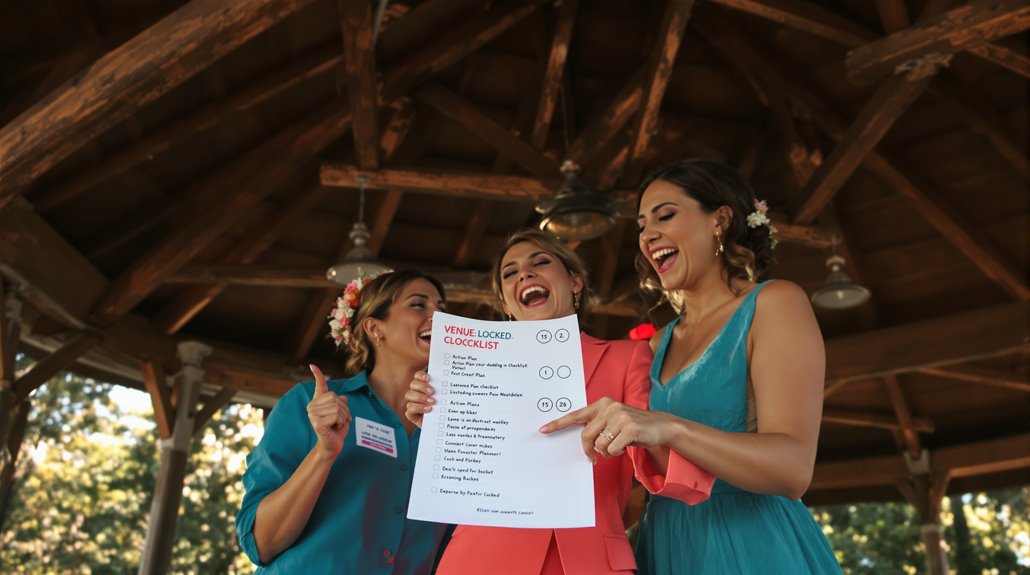
Crafting a wedding action plan that you can screenshot is your secret weapon in beating wedding chaos. Think of it as your project blueprint, not a fluffy Pinterest dream. Start with a streamlined checklist: lock in your venue early. Whether it’s a $150 Mill Valley park or a $27,710 New Jersey hotspot, know your non-negotiables. Then, tackle guest count—remember, costs are linear at $284 per guest. A 100-guest bash might seem smaller but packs a punch at $28,400. Meanwhile, a 200-guest crowd accelerates costs to $60,000. Use metrics to guide your choices, like saving 30% with brunch events. Be strategic: prioritize what matters. Screenshot this, execute it, and avoid the bless-and-stressed cliché. Ready to gain momentum? Let’s move. And don’t forget that practical wedding catering tips can help you streamline your food planning, keeping your menu delicious and your budget in check.
FAQ
So you’re facing a situation that doesn’t match our examples—no problem, just pivot and tailor the strategies to fit your unique chaos. First thing today, create a checklist of non-negotiables and red flags to spot if you’re accelerating too fast, like last-minute vendor changes that can spike costs or regrets about venue decisions. Streamline your approach by knowing if vendor adjustments will impact your timeline and budget—then execute with precision.
What if my situation doesn’t match the examples?
Feeling like your wedding budget doesn’t fit the mold? You’re not alone. Weddings are complex beasts, and your unique situation might not match the typical 200 vs. 100 guest debate. If your guest count or venue choices feel off the charts, it’s time to pivot strategically. Start by calculating your per-guest costs using local medians, not just national averages—these numbers often tell different stories. Consider hidden costs, like extra staffing or rentals, which can sneak up based on location and crowd size. Got a venue offering volume discounts? Leverage those to streamline costs. Remember, efficiency gains aren’t just about cutting edges—sometimes, they’re about smartly reallocating resources. Now, grab your checklist, crunch those numbers, and get moving!
What’s the first thing I should do today?
Wondering where to start on your wedding planning marathon? Let’s cut the fluff and get strategic. Your first move? Nail down your budget—it’s non-negotiable. This number drives every decision, so make it count. Sit with your partner, compare priorities, and decide what gets the lion’s share: venue, food, or those killer photos?
Next, establish a rough guest count. This impacts venue choice and costs. If family’s footing part of the bill, loop them in. With these elements sorted, you’ve got a solid footing to pivot onto date and venue selection. Establishing a firm budget is crucial as it aligns all parties involved on budget expectations and guides your wedding plans.
Reality Check: Investing time here streamlines everything else. Skipping this step? You’re courting chaos. So, grab a coffee, open a spreadsheet, and let’s get this wedding train moving!
What’s the most common regret?
When it comes to wedding regrets, a few common themes emerge that you’d be wise to sidestep. Guestlist size often tops the regret list. Too many invites? It spikes costs everywhere—from venues to vendors—and makes it tough to connect with everyone. Next up, vendor choices. Rushed decisions can lead to chaos; 12% of couples regretted their vendor picks, especially photographers. Don’t skimp on the pros who’ll capture your day. Appearance regrets also loom large—30% wish they’d chosen different attire. The real kicker? Not savoring the day. A 10-hour event can blur if you don’t strategically plan downtime. Your actionable next step: Draft a timeline that prioritizes key moments and anticipates chaos. Treat it like a project, not a fantasy.
What’s a red flag that I’m moving too fast?
How do you know you’re speeding ahead in your relationship like a runaway train? If you’re dismissing your partner’s flaws or ignoring trusted friends’ concerns, it’s time to hit the brakes. When you overlook major incompatibilities or forgive too easily, you’re not strategically evaluating your future. Talk of engagement or life changes within a month? That’s not kinetic energy—it’s reckless acceleration. Lack of community support is a red flag too. Isolation from friends and counselors signals a disconnect from reality. Finally, if wedding planning feels like pulling teeth, with one partner delaying decisions or showing zero interest, it’s time for a reality check. Prioritize clarity and communication. Take a breath, realign, and guarantee your relationship’s foundation is solid before accelerating.
What changes if I add/remove vendors?
Adding or removing vendors in your wedding planning mix isn’t just a tweak; it’s a strategic pivot that can either streamline your budget or elevate your entire event. Hiring fewer vendors reduces costs dramatically. Skip non-essential services, and your budget quickly aligns closer to the median $18,231 rather than the $30,000 average. Want to elevate? Adding premium vendors like full-service planners can transform your day with precision, though they come at a price—$4,100 compared to $1,400 for day-of coordination. Remember, every guest costs $256 on average, so trimming the guest list by 10-15 saves $1,000-$3,750. Your mission? Strategically execute vendor choices to balance ambition with efficiency. Start a vendor checklist and negotiate smartly for off-season deals.
Key takeaways
While planning your wedding might feel like a high-stakes chess game, there’s a clear path through the chaos. You need to decide if you want to go big or keep it intimate because that choice dictates everything else. Here’s how to think about it:
Decide between a grand celebration or a cozy gathering to shape your entire wedding plan.
- Budget Implications: 200 guests at a budget venue might cost around $56,800, while 100 guests at a nicer venue hover between $28,400–$44,000.
- Efficiency vs. Volume: Larger weddings spread fixed costs but can exceed budgets. Smaller gatherings hone in on quality without excess.
- Venue Costs: Nice venues mean higher per-head costs but bring premium experiences.
- Guest Experience: Smaller guest lists allow for more personal connections and curated details.
Reality check: Overspending is common; strategize to avoid it.