
You’re rocking a wedding plan like a product launch, and efficient signage is the secret sauce. Prioritize welcome signs, seating charts, and directional markers—non-negotiable, strategic assets that keep your event moving and your guests informed. Skip the extraneous hashtag and over-the-top decor signs. Track your metrics: costs, cohesion, and killer execution start with the essentials. Want the checklist that’s a career-maker? Immerse yourself in the details that actual pros use to pivot from chaos to clarity.
Quick verdict: What You Need vs. What’s Extra (who each is best for)
In the high-stakes world of wedding planning, you’ll want to know what’s essential and what’s just fluff. Wedding signs ideas can be overwhelming, but let’s cut to the chase. Some wedding signage is non-negotiable for streamlined execution. Here’s your hit list:
- Welcome Sign: Sets the stage, making first impressions and keeping guests oriented. It’s a top priority among necessary signs.
- Seating Chart: Think of it as your guest traffic control—vital for receptions over 50 guests to avoid chaos.
- Directional Signs: Keeps guests from wandering aimlessly. Perfect for complex layouts.
- Bar Signs: Essential for a smooth bar experience, listing your drink offerings and signature cocktails.
Wedding signage not only aids in organization but also enhances the overall experience by helping guests locate important areas and activities efficiently. Reality Check: Overdo it, and your wedding becomes a theme park. Stick to essentials, and you’ll avoid unnecessary stress. Additionally, weather-related disruptions can affect outdoor signage, so consider durable materials to withstand unexpected conditions.
At-a-glance comparison: What You Need vs. What’s Extra
Let’s cut through the wedding noise and get straight to what matters—separating the game-changers from the fluff. Your wedding sign list needs strategic execution. Here’s an at-a-glance comparison:
| Essential | Purpose | Extra |
|---|---|---|
| Welcome Signs | Confirms venue, sets tone | Photo opps |
| Seating Charts | Prevents confusion, central statement | Overly elaborate design |
| Directional Signs | Guides to key spots, prevents wandering | Unnecessary arrows |
| Table Numbers | Identifies tables, cohesive theme | Over-the-top decor |
These essentials streamline your event, ensuring guests know where to go and what to expect. Focus on signs that get the job done efficiently and leave the fluff behind. Incorporating hidden fees into your planning can prevent budget surprises. Signs are not only functional, but they also add colors, theme, and personalization to your wedding decor. Next, let’s explore defining your options so you’re comparing the right things.
Define the options (so you’re comparing the right things)
To nail your wedding signage, you need to strategically separate the essentials from the extras. Essentials are your non-negotiables—welcome signs, directional cues, and seating charts that get the job done efficiently. Directional signs, for example, are essential for guiding guests in large or spread-out venues, ensuring they navigate seamlessly to key areas like the ceremony and reception. Extras, while tempting, include those Pinterest-perfect touches that might not add real value or can lead to budget bloat; know what each option includes, and avoid common misconceptions by focusing on what truly accelerates your day. It’s important to set specific, measurable goals in your wedding planning to maintain momentum and ensure that essentials are prioritized over extras.
What You Need: what it is, what it includes, and the common misconceptions
When it comes to wedding signage, execution is key. You need signs that are strategic and streamlined, not just pretty fluff. Focus on essentials: five to ten signs that get the job done. Prioritize logistics over decoration to keep the day moving smoothly. Welcome signs set the tone and confirm guests’ arrival. Directional signs strategically guide the way to ceremonies, receptions, and restrooms—no wandering lost souls here. Seating charts prevent chaos by clearly assigning tables, while table markers match those assignments, keeping seating organized. Mastering invitation wording establishes the tone for the celebration, ensuring clarity in invitations and enhancing guest appreciation and inclusivity. Don’t fall into the trap of thinking every corner needs a sign; focus on high-traffic areas. Remember, this isn’t a Pinterest board—it’s a precisely executed event. Next step? Create your checklist and execute flawlessly!
What’s Extra: what it is, what it includes, and the common misconceptions
After nailing the essentials, it’s time to explore the extras that elevate your wedding from functional to unforgettable. We’re talking about optional decorative elements that inject personality and visual flair into your big day. Think neon bar signs saying “CHEERS,” monogrammed cake backdrops, or quirky illustrated drink boards. These extras aren’t just for show—they strategically enhance your theme, creating memorable moments. However, don’t mistake them for essentials. Hashtag signs won’t guide guests but amplify social engagement. Retro signs are fun but non-critical. Remember, seating charts are functional, not just décor. Whimsical welcome signs set the tone for the celebration as guests arrive, making them an impactful addition to your wedding’s ambiance. To further ensure a harmonious atmosphere, consider using buffer guests in seating arrangements to separate potential conflicts. Ready to execute your vision with precision? Focus on style-driven extras that align with your narrative. Prioritize what speaks to your story, and skip the rest. Time to pivot and streamline!
Cost breakdown (upfront vs hidden costs)
Let’s break down the real costs of wedding signage, so you know exactly where your money goes. Upfront prices are easy to spot—think standard signs ranging from £20 to bespoke artisan pieces at £200+. But don’t overlook the hidden factors like location, type, and timeline constraints that can quietly inflate your budget—because nothing’s more shocking than a surprise bill, right? Material options, such as metals, acrylic, wood, chalkboard, and mirror, also significantly influence the price, so choose wisely to avoid unexpected expenses. Additionally, venue expenses can consume a significant portion of your budget, so it’s important to consider how signage fits into your overall wedding costs.
Line-item cost comparison by tier/budget
Crunching numbers isn’t glamorous but it’s non-negotiable if you want your wedding signage to be a financial win rather than a budget-buster. Strategically align your budget with the type of signage that gets the job done without hidden costs lurking like a bad plot twist. Remember, custom signage can cost $10+ per sign, adding to your overall wedding stationery expenses. It’s important to recognize that the average wedding costs can vary significantly based on location, with major cities like New York having significantly inflated expenses. Here’s a quick breakdown to keep those numbers under control:
| Budget Tier | Signage Type and Costs |
|---|---|
| Low Budget | £15-£40 for pre-designed signs |
| Standard | £30-£80 for online signs |
| Mid-Tier | £100-£150 mix of bespoke signs |
| High Budget | £120-£300+ bespoke artisan |
It’s all about streamlined execution. Keep an eye on delivery fees, vendor tips, and rush charges—they can pivot your budget faster than you can say “I do.” Next step? Prioritize what truly matters to you.
What actually drives cost changes
When it comes to driving cost changes in wedding signage, it’s the upfront versus hidden costs that can sneak up and spin your budget faster than a rogue confetti cannon. Let’s cut through the fluff and get to the essentials:
- Material Costs: Foam boards are budget-friendly at $25, while acrylic and wood demand $75-$200 and $150+, respectively. LED signs? Get ready for a $300 to $10,000+ range. The price variation is influenced by factors such as location, especially in urban environments where costs can be higher.
- Design Fees: Expect $25 to $150 for basic designs. Custom suites start at $1,300, with calligraphy potentially hitting $3,000.
- Installation Costs: Permits, mounting, and prep range from $50 to $4,000+. Cities hike these up. Hidden costs in weddings, such as service charges and taxes, can increase your budget by 10-15%, making it essential to account for these additional expenses early in the planning.
- Hidden Expenses: Software integration, lifting equipment, and underground wiring can quietly inflate costs.
Reality Check: Prioritize strategically to balance ambition with reality.
Planning workload & logistics impact
Let’s talk logistics—your wedding signage is a project with moving parts, not just another Pinterest board. You’ll need to strategically navigate vendor availability, coordinate with venues, and manage last-minute guest count changes like a pro. Aim for a streamlined approach that respects your time and sanity: consider outsourcing complex installations to pros who can execute with precision and keep your stress levels in check. Be sure to confirm vendor details early and consistently to avoid last-minute surprises and ensure everything runs smoothly.
Time, complexity, and coordination differences
Steering wedding planning is like managing a high-stakes project—one where time, complexity, and coordination play pivotal roles. As an ambitious couple, you’re juggling more than just a color palette. It’s about strategically aligning timelines and executing decisions with precision. Here’s how to keep that hustle under control:
- Start Early: 50% of couples begin 12-18 months ahead. Don’t wait—your calendar’s already packed.
- Simplify Vendor Coordination: Engage 14 vendors on average. Consider a planner to streamline this.
- Prioritize Communication: With 74% creating wedding websites, use tech to reduce chaos.
- Control Costs: Inflation’s a budget-buster. Stay vigilant and re-evaluate priorities monthly.
Remember, each invite represents a financial cost, so align your guest list with your budget and venue capacity to ensure comfort and quality.
Reality Check: Don’t let the excitement overshadow practicalities. Execute smartly, and the day will be as unforgettable as your career wins.
Vendor availability + flexibility considerations
Even the most meticulously planned wedding can hit a snag without the right vendor strategy. To guarantee your big day runs smoothly, you’ll need to be both strategic and flexible with your vendor selections. Here’s how:
- Embrace Off-Peak Timing: Choose midweek or off-season dates to maximize vendor availability.
- Leverage Local Resources: Sticking with local vendors streamlines logistics and minimizes travel headaches.
- Utilize Digital Tools: Platforms like Cvent can match you with vendors pronto, cutting coordination time by over 25%.
- Prioritize Vendor Match: Seek vendors whose style and meticulousness mirror your own—non-negotiable for seamless execution.
Reality Check: It’s easy to get caught up in vendor madness—stay focused on what’s essential and avoid overbooking.
Guest experience impact
When it comes to guest experience, signage isn’t just decor—it’s a strategic tool that shapes perceptions and reduces friction. Execute personalized greetings and real-time event updates to make your guests feel engaged and informed without a hitch. Keep those digital displays working overtime, because a streamlined sign setup means less confusion and more time for your guests to enjoy the party.
How guests perceive it + where friction shows up
Ever wonder why some weddings feel like a breeze while others leave guests wandering aimlessly? It boils down to how strategically you execute signage. Clear, non-negotiable signs streamline guest flow and minimize navigation friction. Here’s how to nail it:
- Welcome Signs: A personalized welcome sets a warm, inviting tone, making guests feel valued from the start.
- Seating Charts: No seating chart? Expect chaos. A well-placed one eliminates guesswork and accelerates seating.
- Directional Signage: Point guests to restrooms, bars, and exits. It’s practical and keeps them from feeling lost.
- Custom Touches: Personalized bar signs with your details? Memorable and adds a touch of curated cool.
Reality Check: Forgetting signage isn’t just an oversight—it’s a recipe for guest stress.
Best-fit scenarios (choose based on constraints)
When you’re managing wedding signage, it’s all about choosing what gets the job done without the fluff. Focus on the non-negotiables if you’ve got a tight budget or a sprawling venue—think seating charts and directional signs that keep guests moving with precision. If you’ve got room to play, add extras that match your theme or vibe, but remember, every sign should earn its keep.
Choose What You Need if…
Steering through the labyrinth of wedding signage can be as tricky as a Rubik’s cube, but nail it, and you’ve got a seamless event that practically runs itself. When deciding what’s essential, forget the fluff—focus on what gets the job done efficiently. If you’re maneuvering a budget-conscious wedding, prioritize signs that are functional and strategic. Here’s your no-nonsense checklist:
- Welcome Sign: Sets the tone without breaking the bank.
- Seating Chart: Avoids chaos, ensuring guests know where to park themselves.
- Directional Signage: Critical for guiding guests in large or unclear venues.
- Restroom Signs: Because nobody wants to ask where the bathroom is mid-vows.
Reality Check: Don’t overthink it. Streamline your signage—maximize impact, minimize cost.
Choose What’s Extra if…
You’ve nailed the basics with strategic signs that keep your wedding on track. Now, let’s talk extras. These additions aren’t just fluff—they’re tactical moves that enhance the day without busting your budget or your sanity.
- Dessert Cards: Go for these only if your dessert bar features unique treats that scream for labels. It’s not a bakery; it’s an experience.
- Transportation Signs: Essential if you’re shuttling between multiple venues. It pivots chaos into clarity.
- Photobooth Signs: Perfect when you’ve got a dedicated photo area and 5-10 signs max. Snap, share, done.
- Social Media Signage: Ideal for casual, phone-friendly events. Boosts engagement without forcing it.
Reality Check: Don’t overdo it. Each sign should serve a purpose. Use them wisely and strategically execute your vision.
Real-world scenarios (examples with numbers)
Let’s break this down with numbers: if you’re hosting 150 guests with a $2,000 budget for signage, prioritize the essentials like welcome signs and seating charts to guide and impress. Got a larger crowd of 300 and a $5,000 budget? You’ll need to strategically execute both functional and decorative elements to keep things running smoothly and stylishly. For an intimate 50-guest affair on a $500 signage budget, focus on a streamlined approach with key pieces like table numbers and a single directional sign to get the job done efficiently.
3 sample scenarios: guest count + budget + priorities
When it comes to wedding signage, strategic decisions based on real-world constraints—like guest count and budget—create a seamless experience. Let’s break it down:
| Guests | Budget | Priority |
|---|---|---|
| 50 | $500 | Navigation |
| 100 | $1,000 | Guest Flow |
| 200 | $2,500 | Information |
For 50 guests on a $500 budget, 5-7 signs—welcome, directional arrows, and seating chart—get the job done. Jump to 100 guests with $1,000, and you’ll need 8-10 signs, including a schedule of events. Double those numbers for 200 guests on a $2,500 budget. Remember, it’s not about Pinterest perfection but executing with precision. Plan, prioritize, and pivot as needed. Ready to hustle? Start with a checklist and timeline.
Common mistakes (and how to avoid them)
Planning a wedding is like orchestrating a high-stakes project where every detail counts and precision is your best ally. To avoid common signage mistakes, here’s how to stay ahead:
- Start Early: Procrastination is the enemy. Leaving signage to the last minute means rushed choices and higher rush fees.
- Know Your Venue: Historic venue? Beware of mounting restrictions. Always verify what’s allowed.
- Mind the Weather: Outdoor weddings need weatherproof signs. A little drizzle can ruin paper signage.
- Consistency is Key: Inconsistent fonts and colors? It’s a surefire way to create visual chaos. Stick to a cohesive theme.
Execution is everything. Strategize, execute, and pivot as needed. Now, grab your checklist and start marking off those boxes. You’ve got this!
Copy/paste decision matrix template
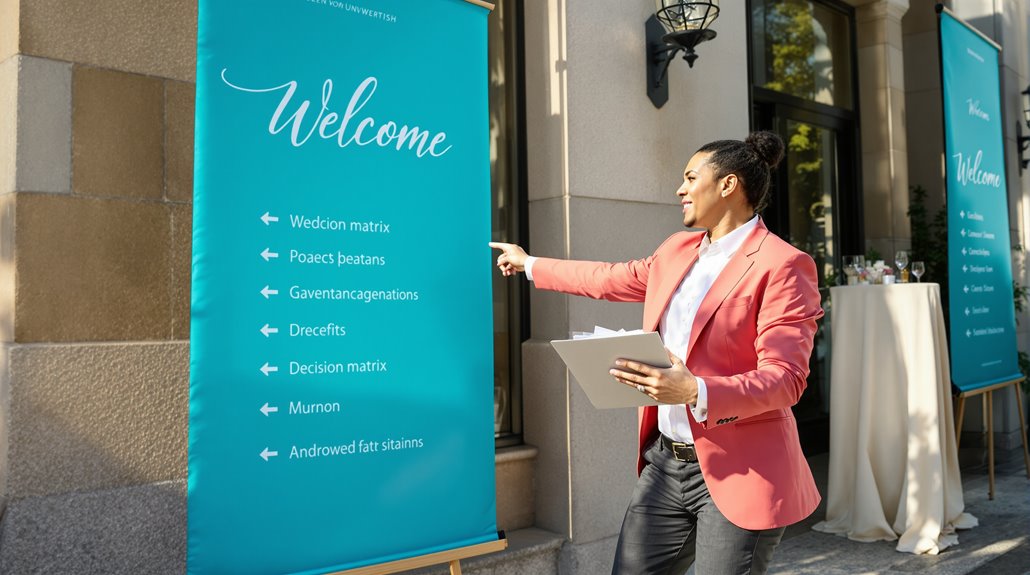
While managing a wedding with the precision of a seasoned project manager, deploy a decision matrix to streamline your signage selection. Copy/paste a decision matrix template to execute objective, quantifiable evaluations. Start by identifying essential from supplementary signage. Does it scream “essential” like a welcome sign or “extra” like a photo booth marker? Weigh criteria based on guest communication, budget, and venue constraints. Score each signage option using a simple scale—1-5 works wonders—and multiply by your criteria weights. This strategic approach guarantees your signage choices are as intentional as your career moves. Compare total scores to prioritize. You’ll pivot from chaos to clarity faster than you can say, “I do.” Next step: Validate with stakeholders, confirming alignment with wedding goals.
FAQ (quick answers to common edge cases)
Stuck between two signage options? Analyze each choice’s impact on guest experience and align with your event’s overall vibe—strategically choosing one will boost efficiency. If guest numbers swing by 20%, pivot by confirming with vendors that your signage can be adjusted without a hitch; this guarantees your event remains seamless.
What if I’m stuck between two options?
How do you choose between two seemingly perfect wedding sign options? First, pivot to priorities: Is it function or flair you need more? If budget’s tight, streamline by focusing on high-impact, essential signs—like seating charts that get the job done. Venue size can also tip the scales; more expansive venues demand directional clarity over decor. Keep style consistent: Limit fonts and match colors. It’s not just about aesthetics; test readability at real-life distances. Your guest count’s another metric to evaluate—more guests mean more signs. Choose practicality over Pinterest. If stuck, use a checklist to weigh each option’s pros and cons. Execute with confidence. Next step? Finalize choices and let the hustle unfold!
What’s the easiest way to reduce risk with either option?
Maneuvering the maze of wedding signage without losing your sanity is all about risk management. Streamline your approach by prioritizing essential signage—think emergency exits, fire extinguishers, and restricted area warnings. These aren’t just signs; they’re your ultimate safety net. Strategically placed restroom and directional signs prevent guest confusion and chaos, while weather-resistant materials guarantee your signage stands tall against unpredictable elements.
Execute a detailed setup schedule to confirm all signs are in place before guests arrive. A venue walkthrough verifies exact placements, while a signage inventory spreadsheet tracks every sign’s location. Assign team roles for efficient setup and ongoing monitoring to maintain visibility and integrity throughout the event. Remember, the right signs aren’t optional—they’re non-negotiable safety champions.
What should I ask vendors to confirm assumptions?
Curious about what you should grill vendors on to verify your wedding day assumptions hold water? Start with team and staffing details. How many people are assigned, and what exactly are their roles? Confirm arrival and departure times to verify seamless execution. Contracts next—get clear on booking confirmations, payment schedules, and cancellation policies. Move to logistics: pin down a detailed timeline, verifying coordination with other vendors. For vision and customization, nail down your aesthetic preferences and any must-have shots. Don’t skip contingencies; ask about backup plans for weather or delays. Finally, quiz them on communication methods—how often, and through what channels, do they keep you updated? Your wedding’s not a wish; it’s a well-oiled machine. Now, get asking!
What changes if my guest count swings by 20%?
You’ve nailed down vendor details, but what happens if your guest count suddenly swells by 20%? First, pivot your welcome sign size. A 2×3 ft board won’t cut it—think bigger, like 24×36 inches. It’s all about visibility. Next, your seating chart needs a strategic upgrade. Double up on 24×36 inch boards to maintain legibility. Directional signage? Add more, especially in large venues. At 18×24 inches each, they guide guests smoothly. For table numbers, increase quantities by 20% to avoid chaos. Your baseline of 5-10 signs should now aim higher—streamline essential categories like welcome, seating, and directional. This isn’t a Pinterest-perfect moment; it’s about execution. Get the job done with precision and controlled chaos. Ready to adapt? Good, now execute.
What’s the best fallback plan if something goes wrong?
When your meticulously planned wedding signage decides to stage a walkout, don’t panic—strategize. First, grab a whiteboard and markers, your unsung heroes. They’re your quick-fix allies for makeshift directional signs or last-minute seating charts. Assign a reliable friend or family member to be your signage director—a role that guarantees all signs are correctly placed and visible. Keep digital backups of your signage designs on a cloud service. If chaos strikes, you can print replacements on the fly. This isn’t about Plan B; it’s about being agile and resourceful. Hustle and Bustle Events knows controlled chaos leads to streamlined success. Remember, it’s not about perfect signs; it’s about making sure guests know where to go. Ready for anything? You will be.
Next steps: make the decision + execute the plan
Once you’ve pinpointed the non-negotiables for your wedding signage, it’s time to strategically execute the plan with precision and flair. First, focus on core elements—logistics over fluff. Consider these streamlined steps to get the job done:
- Prioritize Essentials: List necessary signs like welcome, directional, seating chart, and table numbers. These are your non-negotiables.
- Leverage DIY: Customize online or rally your bridesmaids for a cost-effective, personalized touch. Avoid micro-fonts—think big and bold.
- Coordinate Vendors: Sync with your planner and florist to guarantee style and function align seamlessly. Maximize impact with coordinated displays.
- Test Setup: Dry run your signage at the venue. Confirm clarity and fit—no surprises on wedding day.
Ready for action? Execute with confidence and watch your vision come to life.