
What’s that extra $30K doing in your wedding budget? It’s not lounging, it’s hustling. You’re buying top-tier-worth luxury upgrades: think plush seating, premium catering—your guests’ DIY bar days are long gone. Add pristine staff execution, freeing you to toast the night away. Avoid DIY burnout; you’ve got strategic professionals on speed dial. Surprise: those hidden fees and guest grievances? Strategically managed. So, do you level up or stay basic? Gain momentum and make the call.
Quick verdict: Same Venue at $40K vs. $70K (who each is best for)
Envision this: the same venue, but two totally different price tags—$40K versus $70K. You’re maneuvering a wedding cost comparison at the same venue, and the budget tiers are worlds apart. The $40K option is for those who want a streamlined, no-frills wedding that gets the job done efficiently. The $70K tier, though, accelerates your experience with upgrade costs, pivoting to a more luxurious vibe.
Here’s a quick breakdown:
- Catering and Bar Services: The $70K package often includes premium catering and full-service bar options, elevating the guest experience.
- Vendor Coordination: Full-service coordination at higher tiers means less stress and more strategic execution. This higher tier may also include a guest-tier system to help manage the guest list efficiently.
- Specialty Rentals: Expect upgraded linens and specialty chairs that add a touch of class.
Reality Check: More luxury means more bucks, but less hassle. Choosing a venue with a dedicated coordinator can enhance the planning experience, as it provides a reliable point of contact and reduces wedding stress.
At-a-glance comparison: Same Venue at $40K vs. $70K
Let’s crank up the pace and cut through the noise—you’re staring down the barrel of two wedding price tags for the same venue: $40K and $70K. It’s a spending level comparison that demands precision. At $40K, you get the essentials: space rental, standard rentals, basic catering, standard staffing, and permits. Elevate to $70K, and you’re playing in a different league: enhanced catering, upgraded décor, extended hours, all-inclusive packages, and specialized amenities. Venue location affects budget and guest experience, so consider what aligns best with your priorities. Remember, wedding insurance can offer financial protection for high-stakes investments, ensuring peace of mind for your big day.
Here’s a quick table to see the differences:
| Feature | $40K Package | $70K Package |
|---|---|---|
| Catering | Basic | Enhanced |
| Rentals | Standard | Upgraded |
| Service Hours | Standard | Extended |
| Amenities | Basic | Specialized |
| Vendor Coordination | DIY | All-Inclusive |
Now, pivot these insights into action: weigh your priorities and make intentional decisions.
Define the options (so you’re comparing the right things)
You’ve got two price tags, $40K and $70K, for what seems like the same venue, but let’s dissect what you’re actually getting. The $40K option might include the bare essentials—venue, basic catering, and some standard décor—while the $70K package likely wraps in luxury perks like premium views, exclusive architecture, and all-inclusive services that streamline your planning. Don’t be fooled by vague pricing; understand what’s strategic and what’s superfluous so you can execute a day that’s more “hell yes” than “bless and stressed.” Venue rental costs can range significantly based on factors such as location, included services, and guest capacity, which may account for the $30K difference between the two options. Opting for an all-inclusive venue can provide a more streamlined planning process, reducing stress and ensuring a higher guest satisfaction rating.
Same Venue at $40K: what it is, what it includes, and the common misconceptions
While the allure of a $40K wedding venue might sound like a dream scenario, let’s cut through the noise and get to the core of what this price tag truly covers. At this level, you get tables, chairs, and linens—standard issue, not the stuff of fairy tales. Setup and cleanup? Handled. On-site coordination? Expect it, but don’t expect magic. Climate-controlled spaces? Yes, because climate chaos is a non-negotiable. But here’s the kicker: this is venue-only, not the full wedding package. Misconceptions abound—$40K isn’t your all-in cost. Think of it as the groundwork; you’ll still need florals, specialty lighting, and maybe extra rentals. Remember, $40K in Brooklyn buys more than in Dallas, as venue costs in New York can be significantly higher due to the city’s unique offerings and high demand. Ready to pivot? Start listing necessary add-ons. To effectively manage your wedding planning, make sure to secure venue bookings within the first 30 days to prevent last-minute issues.
$70K: what it is, what it includes, and the common misconceptions
Understanding premium wedding packages is like cracking the code to efficiency in wedding planning. Let’s explore what the $70K gets you that the $40K doesn’t. You’re not buying fluff; you’re investing in a streamlined, all-inclusive experience that eliminates chaos. Think multiple venue spaces, professional in-house teams, and enhanced infrastructure with top-tier sound and lighting systems. You’ll gain a professional design team executing thematic décor transformations—no Pinterest replicas here. With wedding packages, convenience in bundling services together and cost savings are common advantages, making the planning process more efficient for couples. Premium catering means customized menus and craft cocktails, all expertly timed. Coordination? Handled. From vendor contracts to the last dance, a skilled team manages logistics so you can focus on celebrating.
By allocating 3-5% of the budget for music, you ensure a lively atmosphere with professional DJs or bands that match your vision.
Reality Check: Don’t assume more money equals more value unless it aligns with your controlled chaos. Prioritize what moves you!
Cost breakdown (upfront vs hidden costs)
When you’re comparing venue costs, it’s essential to split your focus between upfront pricing and those sneaky hidden fees that can throw your budget off course. The real cost drivers aren’t always obvious, with service charges, mandatory gratuities, and vendor restrictions often inflating your final bill beyond the initial quote. Service fees can range from 18% to 25% of the total bill, covering staff, management, and planning services. Use a detailed checklist to strategically navigate these variables, ensuring your venue choice aligns with your bottom line without any surprise expenses. Sales tax on rentals, catering, and bar packages also contributes significantly to the final cost, and understanding these obligations is crucial to avoid unexpected charges.
Line-item cost comparison by tier/budget
Ready to tackle the dollars and sense of wedding venues? Let’s execute a strategic line-item cost comparison by budget tier. You’ve got options: basic, mid-range, and premium. Here’s a streamlined look:
| Tier | Hourly Rental Cost | Total Venue Cost (Estimate) |
|---|---|---|
| Basic | $40–$150 | $200–$2,000 |
| Mid-Range | $175–$400 | $2,500–$8,000 |
| Premium | $1,800–$5,500+ | $40,000–$70,000 |
These tiers don’t just reflect venue glam—they include must-have amenities and services. Basic packages cover the space. Mid-range adds some flair with catering and AV. Premium? It’s an all-inclusive blitz. Keep your budget in check by noting hidden costs like overtime fees. The geographic location of a venue significantly impacts its pricing, as sought-after areas tend to command higher rates. For example, urban venues typically cost more due to higher demand and the associated amenities. Next steps? Crunch numbers with precision and hustle forward!
What actually drives cost changes
Let’s cut through the fluff and get to the heart of what actually shifts those wedding venue costs. It’s all about strategically managing upfront versus hidden expenses. Here’s what you’re looking at:
- Fixed Venue Operating Costs: These non-negotiable expenses—rent, utilities, insurance—often dominate your budget. They’re constant, no matter how many guests you invite. In cities like NYC or LA, venue costs can range from $25k to $75k, significantly impacting your overall budget.
- Variable Catering and Service Charges: Costs per attendee can accelerate quickly. From catering to service charges, these flexible expenses pivot based on guest count and menu choices.
- Hidden Rental and Equipment Add-ons: Specialized rentals and overtime fees can sneak up on you. These extras, not always obvious, can inflate your budget if not managed. Accurate pricing requires knowledge of both fixed and variable costs to ensure all expenses are covered and profitability is maintained.
Reality Check: Don’t just focus on base prices—uncover all hidden add-ons early. Gain control.
Planning workload & logistics impact
You’re tackling the beast of planning complexity head-on, where time, coordination, and logistics aren’t just words—they’re your non-negotiable allies. Expect vendor availability and flexibility to waltz on a razor’s edge, demanding you strategically juggle timelines and resources like a seasoned circus performer. So, map out every move with precision, because in this game, chaos gets tamed, and your wedding day marches to the beat of your well-executed plan. Remember to allocate 20-35% of total budget to the venue to set realistic expectations and prevent overspending.
Time, complexity, and coordination differences
When you’re juggling a wedding with the precision of a NASA launch, time becomes your most valuable asset. Strategic planning and streamlined execution are non-negotiable. You want results, not chaos. Here’s what you gain by investing in time and complexity management:
- Streamlined Processes: Automate repetitive tasks, freeing up hours for strategic moves rather than manual calculations. Think: from 101 hours to just 5 per quarter.
- Resource Allocation: Misallocated staffing can blow your budget by 25%. Efficient scheduling, driven by real data, guarantees every dollar works its hardest.
- Real-time Tracking: Budget management tools provide immediate insights, preventing the hidden costs that can escalate without warning.
Planning ahead can help avoid hidden costs such as taxes, gratuities, and service fees, which often accumulate unexpectedly and strain the budget.
Reality Check: Prioritize smart coordination. Overspending isn’t just a financial risk—it’s a time thief. Use tech to pivot efficiently.
Vendor availability + flexibility considerations
A well-executed wedding demands the same precision as a high-stakes corporate merger—only with better catering. When you’re planning, vendor availability becomes your lifeline. To secure top talent without losing your mind, tackle these non-negotiables:
- Start Early: With rising vendor costs, negotiating is king. Schedule 6-9 months in advance to lock in your first-choice vendors. This isn’t just smart—it’s necessary.
- Embrace Flexibility: Contingency plans aren’t just buzzwords; they’re sanity savers. Hybrid options and flexible contracts keep chaos at bay.
- Streamline Coordination: Use digital tools for proactive communication. This means fewer late registrations and vendor hiccups, keeping your timeline intact.
Guest experience impact
You’re not just picking a venue; you’re engineering an experience. When you strategically choose a premium location with bundled services, every guest feels the difference—from seamless logistics to elevated amenities. If you spot friction points like long lines or chaotic changes, it’s time to pivot your approach and streamline the execution for a flawless event.
How guests perceive it + where friction shows up
Ever wonder why the same venue can hit your wallet differently at different times? Pricing perception is a game of transparency and strategic communication. Guests value clarity, and when they get the inside scoop on why prices fluctuate, fairness ratings jump 3.38 points.
Consider these friction points:
- Transparency Troubles: Without clear reasons for price hikes, guests might think you’re pulling a fast one. Explain the rationale, and the friction fades.
- Seasonal Shifts: Peak periods justify premium pricing. Off-peak? Guests balk at high rates, forcing a pivot to discounts or bundles.
- Value Visibility: Guests need to see what they’re paying for—think killer amenities and superior service. Articulate the value, and acceptance gains speed.
Reality Check: Lack of clarity? That’s a non-starter.
Best-fit scenarios (choose based on constraints)
You’re eyeing the same venue but torn between the $40K and $70K options—let’s cut to the chase. If you’re confident in your vendor management skills and don’t mind coordinating rentals, the $40K raw space is your playground. But if your schedule’s packed tighter than a rush-hour subway, the $70K all-inclusive package streamlines the chaos, bundling essentials like catering and staffing, so you can focus on what really matters—executing your vision with precision.
Choose Same Venue at $40K if…
When the stakes are high and your time’s even tighter, choosing the $40K option for your venue becomes a strategic move that aligns with your ambitious lifestyle. This choice is for you if you value efficiency and execution over extravagant add-ons. Here’s why the $40K venue gets the job done:
- Streamlined Essentials: You get all the basics without the unnecessary fluff. Think essentials executed with precision.
- Budget Control: Keeps your finances nimble, allowing you to invest elsewhere—like a killer DJ to keep the vibe kinetic.
- Efficient Planning: With fewer variables, your planning timeline accelerates, fitting seamlessly into your packed schedule.
Reality check: It’s not about cutting corners; it’s about making intentional decisions. Trade-offs? Fewer frills, but more focus on what really matters.
Choose $70K if…
Opting for the $70K venue isn’t just a splurge—it’s a strategic investment in delivering a wedding experience that’s as high-octane as your lifestyle. If you’re a mover and shaker with zero time to spare, here’s why you should go big:
- Precision Execution: Get a dedicated team that treats your wedding like a high-stakes project, ensuring every detail is executed flawlessly, from logistics to ambiance.
- Time-Saving Amenities: Enjoy on-site coordinators and streamlined services that cut planning time and stress in half. It’s a non-negotiable for those with a packed calendar.
- Curated Cool Factor: Access exclusive partnerships and bespoke options for a vibe that screams “you” without the hassle.
Reality Check: This choice is for those who prioritize efficiency and impact—proof, not promises.
Real-world scenarios (examples with numbers)
Imagine this: you’ve got a guest count of 100, a budget of $10,000, and a non-negotiable priority for killer food. You could opt for a suburban venue package that includes catering and basic decorations, maximizing value while keeping it streamlined. Want to pivot to a higher-end experience? Add $7,500 and you’re in downtown DC’s Four Seasons with all its premium perks, but remember, this choice impacts your budget for other essentials.
3 sample scenarios: guest count + budget + priorities
Let’s cut to the chase: you’re not here to daydream about flowers and cake; you’re here to execute a wedding plan that works as hard as you do. So, what does $40K vs. $70K really buy you? It’s all about guest count, budget, and priorities. First, decide if you’re hosting 145 guests or keeping it intimate. Next, pinpoint what’s non-negotiable: premium amenities or budget-friendly elegance? Finally, find your venue sweet spot:
| Scenario | Venue Cost | Guest Count |
|---|---|---|
| Manhattan Extravaganza | $96,910 | 200+ |
| Wyoming Intimate | $3,770 | 50 |
| Bay Area Standard | $25,000 | 145 |
Strategically allocate your budget to match your priorities. Don’t let wedding planning bless and stress you. Pivot with precision and remember: execution over indulgence. Next, draft your checklist and timeline.
Common mistakes (and how to avoid them)
When selecting a wedding venue, rushing the process is a rookie mistake that’ll cost you more than just cash; it’ll eat up your sanity. Avoid common pitfalls by strategically planning every move:
- Plan and Timeline: Start early. Don’t be that couple scrambling for bookings. Know precisely what you need from the get-go—your venue should fit your event, not the other way around.
- Location and Accessibility: Don’t sabotage your guest list. Choose a venue that’s easy to reach with ample parking and public transport options. Remember, convenience is king.
- Physical Inspection: Don’t rely on those glossy brochures. Visit in person, inspect lighting, acoustics, and layout. Be the detective your wedding deserves.
Execute these steps with precision, and your venue choice will be flawless.
Copy/paste decision matrix template
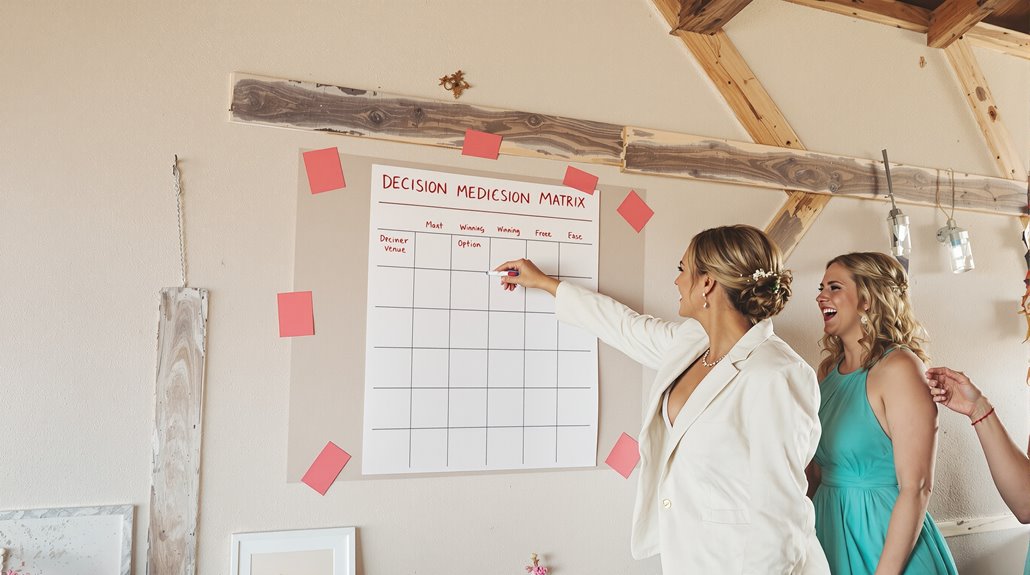
Although decision-making can feel like a maze, a decision matrix template slices through that chaos with razor-sharp precision. You’re juggling a million wedding decisions; a decision matrix, though, gets the job done like clockwork. It’s simple: list your criteria—cost, quality, delivery time—assign weights from 1-5, and plug in options. Raw scores multiply with weights to reveal which choice carries the most weight, literally. Excel, Google Sheets, or any project management software can execute this seamlessly. No fluff, just facts. We’ve all got careers to run, so let this template streamline your venue decision. Action plan: List your options, apply the matrix, and let the highest score guide you. Remember, it’s not about Pinterest perfection but strategic execution.
FAQ (quick answers to common edge cases)
Stuck between venue options? Start by strategically mapping out a risk-reduction plan—because who doesn’t love a good contingency? Confirm assumptions with vendors upfront and prepare for a guest count pivot by securing a flexible contract; it’s your non-negotiable safety net.
What if I’m stuck between two options?
So, you’re caught between two venue options and the clock’s ticking—what’s your move? First, get real about your priorities. Is proximity to the city center a non-negotiable, or is state-of-the-art tech your jam? Factor in guest count: more guests equal more space, and that ramps up costs. Check if either venue’s offering early bird discounts; it’s like finding a unicorn in wedding planning. Use checklists to compare amenities—on-site catering and modern infrastructure are game-changers. Strategically, a venue with a strong market position might ease stress with seamless execution, but it’ll cost more. The takeaway: prioritize what accelerates your planning process. Evaluate, decide, execute. Because, really, who’s got time for bless and stressed? Move forward confidently!
What’s the easiest way to reduce risk with either option?
Reducing risk in wedding planning isn’t about crossing fingers—it’s about execution with precision. Start by conducting a focused threat assessment. Identify high-risk elements like outdoor venues or pyrotechnics and assign owners for each. Document everything in a central register to keep things streamlined. Invest in backup systems for critical equipment—because “bless and stressed” isn’t your style. Guarantee vendor accountability with insurance certificates and diversify vendors to avoid single-point failures. Use technology to pivot quickly: real-time crowd analytics and automated notifications keep you ahead. Establish clear emergency protocols, guaranteeing everyone’s roles are defined. Secure insurance covering postponement and nonappearance. Now, you’re ready to execute like a pro. Next steps? Get your risk register going and lock down those insurance details.
What should I ask vendors to confirm assumptions?
How do you guarantee your event won’t go off the rails? By locking down vendor confirmations like a pro. First, insist on contracts that outline delivery times, payment terms, and cancellation clauses. Confirm venue details: address, directions, and parking—non-negotiable. Secure day-of contacts with each vendor to tackle any hiccups. Schedule an A/V run-through the day before to make sure tech won’t betray you. Verify all permits and insurance; no one needs last-minute legal drama. Discuss weather contingencies for outdoor events, and document them. Accessibility and security? Confirm through a walkthrough with stakeholders. Finally, align your team with an event-day schedule detailing timings and roles. Make certain everyone’s ready to hustle. Next step: lock in these confirmations well ahead.
What changes if my guest count swings by 20%?
When your guest count swings by 20%, you’re not just adjusting a headcount—you’re executing a full-scale pivot. Imagine your venue as a dynamic puzzle; change the pieces, and the whole picture shifts. Venue costs? They’ll jump about 20%, possibly bumping you into a higher price tier. Catering and staffing? Expect a 20% increase in food, drinks, and staff. Your floor plan gets a facelift—more tables, chairs, and bustling energy. But be strategic: overcrowding can kill the vibe and personal touch. A smaller guest list might let you level up with gourmet menus or custom touches. Remember, contracts love surprises, so brace for minimums and overages. Ready to juggle those RSVPs with precision? Time to hustle!
What’s the best fallback plan if something goes wrong?
In the chaos of wedding planning, nothing throws a wrench in the works like the unexpected. You need a fallback plan that’s executed with precision. Imagine weather disasters, vendor no-shows, or tech glitches. Your strategy? Redundancy is key. Secure backup venues—think tents for outdoor events or alternate indoor spots. Equip yourself with spare AV gear and test it. Have an on-call team of trained staff ready to pivot. Compose pre-drafted communication for quick updates. Stay ahead with proactive vendor confirmations. An emergency contact list? Non-negotiable. Draft step-by-step emergency procedures, because when chaos hits, you’ll want to be the one who’s prepared. Next step: Create a checklist of backup resources and contacts—because winging it isn’t an option.
Next steps: make the decision + execute the plan
Once you’ve navigated the labyrinth of venue options and honed in on your dream location, it’s time to pivot from decision paralysis to execution mode. You’re not just booking a venue; you’re orchestrating a symphony of logistics. Here’s how you implement like a boss:
- Finalize the Deal: Confirm dates, lock in pricing, and scrutinize the contract for hidden fees. Negotiate like you’re buying a house, not just renting space.
- Create a Timeline: Map out every milestone—from vendor coordination to guest RSVPs—so nothing falls through the cracks. Use project management tools that streamline communication and keep everyone on the same page.
- Budget Smartly: Allocate funds strategically. Prioritize essentials over extras to guarantee a seamless experience without surprise expenses.