

You’re spinning controlled chaos into sleek elegance for your $100K wedding to look like $50K. How? Execute with precision. Streamline—cut guest lists, go seasonal. Use checklists, timelines for killer quotes. Prioritize essentials: venue, photography, then sprinkle magic where it counts. Avoid hidden costs—bad contracts are wedding kryptonite. Monday weddings can save 30%, no ROI on glitter-covered nonsense. Now, shift gears towards mastering efficiency over wedding-day dreams and discover what’s next.
Cost snapshot
Let’s dive straight into the dollars and sense of wedding planning. When you consider the luxury wedding cost perception, it’s easy to picture opulence and extravagance. But the expensive wedding reality can differ based on strategic decisions. Here’s a luxury wedding breakdown to guide your planning:
- Location Matters: Mid-Atlantic weddings hit a high of $46,000, while Midwest and Southwest options average $29,000. Choose wisely!
- Seasonal Shifts: Summer weddings peak at $34,000, so consider an off-season date for savings.
- Guest List Economics: Ultra-luxury events can spend over $2,900 per guest—opt for a micro wedding if that’s a non-negotiable.
- Destination Considerations: Expect to fork out $39,000-$41,000, depending on where you go. Venues and suppliers contribute heavily to overall expenditure, so prioritization of spending is essential for budget management. A crucial factor in wedding planning is the venue cost, which can account for around 17% of the total budget.
Plan smartly, and pivot where necessary!
What you’re actually paying for (cost structure)
You know what you’re really shelling out for at your wedding? In a high budget wedding, it’s all about strategic allocation. Venue and catering scoop up a hefty slice of your budget, gobbling up around 24% solo. It’s not just about the space; you’re paying for the ambiance, food, drinks, and that seamless service that doesn’t leave Aunt Sally waiting for her wine. Photography and videography? Non-negotiable essentials capturing memories with precision, consuming about 7-12% of your funds. Floral décor and entertainment add flair, but they’re not just pretty extras—they’re carefully executed elements that make your wedding pop. Pivot from dreaming to doing with a checklist. Prioritize what truly matters to you and streamline the rest. It’s important to note that while the average cost of a wedding in the U.S. in 2025 is $33,000, costs can vary significantly based on location and personal choices. Couples often neglect hidden costs in vendor contracts, which can lead to unexpected expenses and budget overruns.
Cost drivers (what moves the quote the most)
When it comes to what really cranks up that wedding quote, location is the heavyweight champ. You could fork out $70K in Washington D.C., while Utah’s got you covered at a cool $17K. Imagine the same guest list in San Francisco versus Milwaukee—you’re looking at double the costs. So, what else gets that budget fired up?
- Venue Costs: They’re the big ticket, sucking up 17% of your budget, with variances depending on where you say “I do.”
- Vendor Labor: Photographers, bands, and planners have upped their game—costs have spiked.
- Supply Chain Woes: Flowers and fabrics take a hit with those pesky premiums.
- Guest Count: Each guest sets you back $284. Trim that list and breathe easier.
- Hidden Fees: Unexpected expenses like service charges, vendor overtime, and taxes can inflate the budget by 10-15%.
Reality Check: Location’s non-negotiable. Choose wisely. The average wedding cost in 2025 is $36,000, marking an increase from previous years, and highlights the importance of strategic budgeting.
Example scenarios (3 budgets x 3 priorities)
While juggling a full-throttle career and planning the wedding of your dreams, it’s essential to strategically allocate your budget to match your top priorities without losing your sanity. Let’s break down three scenarios, showing how you can pivot your budget without sacrificing your non-negotiables:
| Priority Focus | Key Budget Moves |
|---|---|
| Venue-Centric | Venue eats 27%, food gains, décor compresses |
| Photography-Focused | Photos jump to 15%, venue holds, entertainment trims |
| Entertainment-Driven | Band/DJ jumps to 10%, guest fun emphasized |
Your budget is your strategy map, not a wish list. Execute each dollar with precision. Want that venue to wow? Let the food do the talking. Need killer photos? Trim the fluff. Each choice accelerates your vision. Bless and stressed? No thanks. Pivot smartly—get it done. Flexible budgeting allows for adaptation to life changes without sacrificing financial goals. Whether you’re planning a small wedding or a large event, remember that guest count significantly impacts the overall budget.
How to get accurate quotes fast
How do you cut through the noise and get accurate quotes faster than your morning espresso kicks in? Here’s how to streamline your vendor selection process and maximize efficiency:
- Be Precise: Send detailed lists of expectations and deliverables to each vendor. This clarity prevents scope creep and guarantees quotes reflect your exact needs. By using cost estimation software, you can further reduce the time it takes to gather these quotes by up to 90%.
- Compare Quickly: Request estimates from multiple vendors at once. This accelerates your ability to spot the best value and strategically allocate your budget. Aligning guest count with budget is crucial to ensure that your vendor selections are both realistic and within your financial plan.
- Get It in Writing: Written quotes are non-negotiable. They include budgets and service descriptions, protecting you from misunderstandings.
- Seek Extra Value: Choose vendors offering value-adds or discounts. This gains budget efficiency and keeps you under financial targets.
Mistakes to avoid
If you’re not careful, wedding planning can quickly turn into a financial black hole that devours your budget faster than you can say “I do.” Let’s face it: setting realistic budgets is the cornerstone of any successful project, and your wedding is no exception. To dodge budget-busting pitfalls, consider these key mistakes:
- Unrealistic Budget Setting: Don’t book vendors without a clear budget. Your spending should match your financial reality, not what your cousin’s blog suggests. A contingency buffer of 5-15% can help manage unexpected costs and provide financial security.
- Venue Overspending: The venue is the budget’s heavyweight. Opt for off-season dates to save and guarantee you’re not paying extra for basics like chairs.
- Vendor Cost Underestimation: Get full proposals early. Always check for those sneaky hidden fees.
- Contract and Fine Print Negligence: Read every contract word. Ignorance isn’t bliss—it’s costly. Establishing limits early on spending helps maintain control and prevents financial strain during the planning process.
Next up, prioritize!
Quick cost checklist you can screenshot
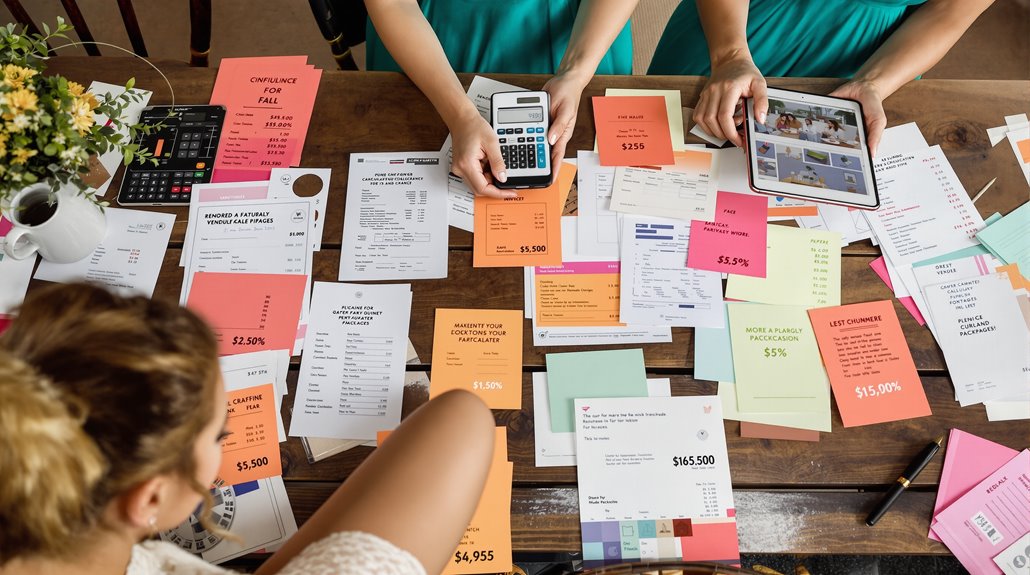
Let’s cut to the chase: wedding planning isn’t just about picking colors and flowers—it’s about knowing where every dollar goes. You want a budget that feels like a boss move? Screenshot this quick cost checklist and get back to your day job:
Wedding planning: it’s all about smart budgeting, not just the pretty details. Know your dollars.
- Venue/Reception: 40-50%—Hunt for all-in-one packages; they save more than just time.
- Catering/Cake: 20-30%—Decide between plated or buffet. Don’t sleep on vendor meals.
- Photography/Videography: 10-15%—Multiple packages mean more angles, less stress.
- Attire/Beauty: 5-10%—Factor in alterations; they’re non-negotiable.
- Entertainment: 5-8%—DJ or live band? Pick your vibe. Venue costs can account for 40-50% of the overall wedding budget, so it’s crucial to allocate wisely.
Reality Check: Skimping here means scrambling later. Execute with precision—no one wants a surprise budget overrun. Median wedding cost provides a clearer picture of typical spending, so use it as a benchmark to avoid high-end event inflation. Pivot smartly, accelerate decisively.
FAQ
Ever wonder why your meticulously planned wedding budget feels as stable as a Jenga tower in an earthquake? You’re not alone. Most couples plan to spend $22,500 but actually fork over $30,000–$36,000. Why? Hidden costs. Service charges, gratuities, and those irresistible last-minute adds. Inflation’s another pesky culprit, driving up vendor prices consistently. Venues, catering, and bars gobble up 40–45% of your budget. Want to trim costs? Consider a weekday or winter wedding. You’ll save 20–30% on vendors. Cut the guest list by 10–15 people, and you could pocket $1,000–$3,750. Use timelines and checklists to keep chaos controlled. Many couples rely on parental support to meet their desired wedding budgets. Streamlining your guest list to around 116 can help manage costs without sacrificing quality. Remember, it’s about making smart, intentional decisions. Ready to hustle smart? Start by slashing hidden costs with a strategic plan.
Key takeaways
Achieving a dream wedding on a budget isn’t about cutting corners; it’s about making mastery-level moves. You’re not sacrificing quality; you’re executing a plan that gets the job done smartly. Here’s your quick guide to turning that $100K wedding into a $50K stunner:
- Strategically Choose Vendors: Focus on those who match your vibe and can deliver under pressure. No room for “bless and stressed” here.
- Streamlined Decor: Opt for bold impact pieces over endless fluff. Less can be more when executed with precision.
- Prioritize Non-Negotiables: Decide what’s indispensable and allocate your budget accordingly—cut the fat, keep the filet.
- Efficient Timelines: Use a project management approach. Set milestones, measure gains, and pivot as needed.
- Leverage Off-Peak Dates: Opting for off-peak dates such as weekdays can yield better rates and significant savings, allowing more flexibility in your budget.
Reality Check: A killer wedding isn’t about the spend; it’s about the strategy.