

Cutting your wedding guest list shouldn’t feel like brain surgery. Start with three tiers: non-negotiable Tier 1, would-love-to-have Tier 2, and nice-to-have Tier 3. Keep it confidential—no drama needed. Categorize swiftly using metrics like relationship priority. Then chisel away strategically, like a career pro with a timeline. Streamlined decisions trump fluffy daydreams. Your focus accelerates results. And remember, building this system now means fewer headaches later while revealing savvy next steps.
What you’ll accomplish (and what ‘done’ looks like)
When you tackle the guest list with our three-tier system, you’re not just listing names; you’re executing a strategic operation that respects your time and budget. The guest list tiers system is your secret weapon, dividing invitees into must-invites, would-love-to-have, and nice-to-have. It’s a guest priority system that categorizes guests into non-negotiable essentials and strategic backups. You’re moving with precision, ensuring that your celebration is streamlined and meaningful. This system lets you pivot quickly when adjustments are needed, without the stress. You’ll gain clarity, knowing exactly who’s in each tier and why. By prioritizing your guest list management, you also help keep catering and venue costs under control, which are two of the most significant budget drivers. By the end, you’ll have executed an efficient plan that gets the job done, delivering a joyful day with people who truly matter. The final guest count is influenced by venue capacity, budget, and the desired wedding vibe, ensuring that only the most important people share in your special day.
Quick start (the short version)
Let’s cut the fluff and get straight to it. Here’s your quick start guide to a tiered guest list that gets the job done efficiently:
Quickly organize your guest list with a tiered approach for efficient planning.
- Draft a Thorough List: Write down every name you can think of—no exceptions. This is your brainstorming phase; don’t worry about cuts yet. Having a detailed list guarantees you won’t overlook anyone important.
- Establish Three Tiers: Categorize your list into three priority levels. Tier 1 is non-negotiable, Tier 2 is would-likes, and Tier 3 is nice-to-haves. This strategic approach accelerates decision-making and eases future cuts. Prioritize relationships over numbers to ensure that the people who matter most are included in your final guest count.
- Set Clear Ground Rules: Define maximum guest numbers, plus-one policies, and rules on children. Be consistent and document everything. These guidelines pivot your planning from chaos to controlled execution.
Now, execute!
Before you start: inputs you need
Before diving into guest list chaos, arm yourself with essential intel to guarantee everything runs like clockwork. Let’s streamline this process so you can pivot gracefully later on.
- Budget Details: Calculate per-person costs—think food, drinks, rentals. Nail down your comfortable spending per guest early. This isn’t fluff; it’s your guest list’s backbone.
- Venue Capacity: Secure your venue to confirm the maximum number of attendees. Venue limitations are non-negotiable—over-invite, and you’re in a world of hurt.
- Guest Categories: Strategically categorize guests: immediate family, friends, colleagues. Use tiers to differentiate between must-haves and nice-to-haves. Prioritize like a pro. Establish the overall size and scope of the wedding to ensure your guest list aligns with your vision and resources.
Reality Check: Overlook these, and you’re blessing and stressing. Execute this prep, and you’ll cut chaos, not corners. Next up: mapping your guest list strategy.
Step-by-step process
You’ve got a wedding to plan, so let’s cut the fluff and get strategic. First, clarify your constraints—think date range, budget ceiling, and those non-negotiables that make or break the guest list. Once that’s done, build your decision order to streamline the process, create a timeline with clear milestones, and execute vendor outreach with precision, locking everything down with contracts and contingency buffers. A helpful tactic is to standardize your RFP formats when requesting vendor quotes, making it easier to compare costs and avoid surprises as you finalize your plans. Remember, it’s crucial to establish a venue and budget before creating a guest list, as this will guide your planning decisions and help manage expectations effectively.
Step 1: Clarify constraints (date range, budget ceiling, non-negotiables)
When you’re diving into wedding planning, the first step to success is clarifying your constraints with laser focus. First, set your budget ceiling. Calculate the cost per guest by dividing your total budget by venue capacity—this’ll keep your spending in check. Remember, the guest count dictates costs for food, invitations, and more. Next, assess your venue’s capacity. This is a hard limit—safety and logistics hinge on it. Choose your date range early to allow room for tweaks as RSVPs roll in. Non-negotiables? Identify your VIPs: immediate family and closest friends. Tier them strategically. Collaborate with your partner; compare lists, spot overlaps, and set criteria together. Allocating 20-35% of your total wedding budget to the venue can help you set realistic expectations as you shape your guest list. Digital invitations can be a cost-effective option that aligns with budget constraints. Get ready to execute the plan. Next up, build your decision order!
Step 2: Build the decision order (what to decide first so everything else is easier)
Now that you’ve nailed down your constraints, it’s time to kickstart the decision order with precision. First, estimate your total guest capacity to guide venue choice and budget—think of it as setting your wedding’s bandwidth. Use a formula: 50% close friends, 30% family, 20% professional connections. With this, you’re not just planning, you’re strategically executing. Next, identify your must-have core group: immediate family, wedding party, and those you can’t imagine the day without. Prioritize this A-list, ensuring both partners’ VIPs are included. Additionally, split guest list spots evenly between both sets of parents to maintain fairness and avoid any potential family resentment. This approach helps you manage expectations and supports high guest satisfaction for everyone involved. Finally, tackle plus-ones and children policies. Decide early to dodge last-minute chaos. Set clear rules for who gets a plus-one or which kids make the cut. This is your streamlined launchpad to smarter choices.
Step 3: Create the timeline (milestones + deadlines)
Crafting your wedding timeline is like engineering a well-oiled machine, where every milestone aligns perfectly with your ambitious schedule. Start by setting your initial guest list 12-9 months out, categorizing into must-haves and nice-to-haves. Collect addresses and send save-the-dates early—9-12 months for destinations, 6-8 for locals. At this stage, it’s also a good idea to book a professional stationer 6-9 months prior to ensure your designs are tailored to perfection.
At 8-6 months, order invitations and set an RSVP deadline to lock in catering and seating. Use spreadsheets or RSVP systems to track responses. By 4-3 months, finalize your guest list, adjusting only for RSVPs. Building in buffer times at this stage helps prevent last-minute stress or overlooked tasks. One month out, chase non-responders and submit a final headcount. Always track dietary needs and under-21 guests. Finalize your seating chart and keep everything streamlined in a shared system. Next, prepare vendor outreach.
Step 4: Execute vendor outreach (scripts + tracking)
In the bustling world of wedding prep, vendor outreach is your next power move. Executing it with precision and speed is non-negotiable. Start by identifying your top-choice vendors online—94% of couples do. Craft sharp, personalized scripts for email, your go-to communication tool, and prep for follow-ups via phone or video calls. Social media engagement isn’t just a nice-to-have; it’s your strategic advantage. To maximize your outreach, establish a clear vendor decision order to prioritize which vendors you contact first and streamline your planning process. Track every response meticulously; automate replies but keep them personal. Use inquiry codes and local data to measure what works. Remember, 57% of couples need swift responses—don’t lag. Prioritize networking; it boosts your conversion game. Networking with other vendors is highly beneficial, as 50.4% of wedding professionals believe it to be very important. Ready to streamline this chaos? Get your scripts and tracking systems in place, and watch your vendor relationships accelerate.
Step 5: Lock the plan (contracts, deposits, and contingency buffers)
Locking down the plan is where your wedding vision gains real traction. It’s time to execute like a boss. Secure your venue by ensuring contracts specify maximum guest capacity and layout configurations. Deposits are non-negotiable—they lock in your date and price, shielding you from pesky cost hikes. Strategically structure vendor agreements to include a buffer for extra guests and accommodate dietary restrictions. Use spreadsheet-based tracking systems for seamless collaboration and real-time updates. Budget protection is your secret weapon: Tier your guest list to maintain financial flexibility, activating B-list invites only when needed. Don’t forget a contingency buffer of 10-15% for unexpected expenses. Next, confirm your systems are in place to manage RSVPs efficiently. Now, let’s hustle. Remember that service charges and hidden fees can impact your final catering bill, so clarify these costs with your vendors upfront to avoid budget surprises.
Step 6: Run weekly check-ins (how to stay on track without spiraling)
While everyone else is busy crafting mood boards, you’re about to master the art of staying on track without losing your mind. Immerse yourself in weekly check-ins like a boss. Start by scanning RSVP statuses—confirmed, pending, no-response? Got it. Use organization tools to filter guests by tags or priorities, and track who’s opened invites. Your mission? Execute reminders proactively. Fire off RSVP nudges a month out, then two weeks, then one. Automate these—it’s non-negotiable. Monitor RSVPs and gift purchases in real-time. As you reassess guest tiers, dynamically adjust based on response rates. Limit plus-ones and streamline seating charts. You’re not just planning a wedding—you’re running a strategic operation. Next step? Finalize those lists a month out, print, and execute. Make sure to maintain a structured timeline so you can efficiently manage guest communications and avoid last-minute chaos.
Template you can copy/paste (checklist + tracker)
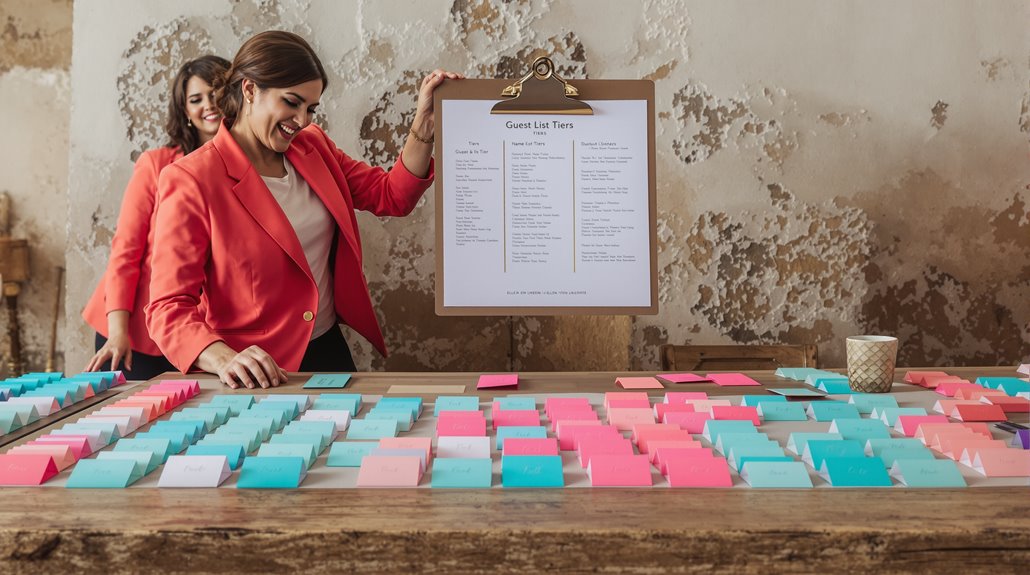
You’re about to execute a streamlined guest list that’s as efficient as your morning coffee run. This copy/paste template isn’t just a list—it’s your strategic command center. Begin with columns for Guest Name, Address, and Contact Details. Track everyone invited, plus their RSVP status and any dietary restrictions. Need to juggle gifts or manage plus-ones? Check. Assign roles and sort by tier—Tier 1 is non-negotiable, while Tier 3 is cuttable. Use separate Excel sheets for each event. Filter by RSVP, role, or alphabet to gain insights quickly. Your guest list isn’t just a task—it’s a project. Execute it like the pro you are. Ready to pivot from chaos to control? Let’s move. Remember to define guest list according to your venue capacity and budget constraints to prevent over-inviting and future headaches.
Common mistakes (and how to avoid them)
Executing a guest list strategy requires more than just good intentions; it demands precision and savvy decision-making. Don’t let common pitfalls derail your progress. Here’s how to navigate the chaos:
Precision and savvy decision-making are essential for executing a successful guest list strategy.
- Inconsistent Tier Definitions: Keep your tiers uniform. A mismatched split between partners leads to tension. Define tiers clearly—Tier 1 for must-invites, Tier 2 for close circles, Tier 3 for acquaintances. Stick to it.
- Overestimating Declines: Assuming RSVPs will drop off? Rookie mistake. If your venue caps at 100, don’t send 130 invites expecting declines. Trim early and often using interaction tests, like recent one-on-one dinners.
- Revealing Tiered System: Want to cause drama? Mention your tiering system. Instead, frame cuts as prioritizing close relationships due to venue size. Respect others’ feelings by keeping mum.
Using core values as a guide can help couples prioritize who truly matters, making cuts less stressful and more intentional.
Leverage these insights for a streamlined, non-negotiable guest list that gets the job done.
FAQ
Got questions? Let’s tackle them head-on. If you’re swamped, a streamlined guest list can be executed in a week—strategically prioritize Tier 1 and delegate the rest. Track RSVPs and vendor responses weekly, and if someone goes radio silent, pivot fast; your wedding project deserves precision and momentum.
How long should this take if we’re busy?
Juggling a high-octane career while planning a wedding? You’ve got this. Building guest list tiers doesn’t have to be a time sink. Start by dedicating 2-4 hours initially, spread over sessions. A quick 30-60 minute brain dump of potential guests kicks things off. Categorizing into A, B, and C tiers takes 1-2 hours together, while strategic ranking based on interaction frequency adds another 45-90 minutes. Busy schedule? Streamline with spreadsheets and partner input, saving up to 50% effort. A 1-hour joint session can halve solo time. Break tasks into 30-minute daily sprints for a week. Secure your venue first to accelerate decisions. Remember, precision and strategic execution make this manageable. Next up? RSVP tactics.
What’s the minimum version that still works?
Ever wondered how to streamline your wedding guest list without losing your mind? Let’s cut the fluff and get down to business. The minimum version that still works uses a two-tier system: A-list non-negotiables and B-list opportunistic invites. Start by executing a brain dump of all potential guests, then strategically highlight your top-tier non-negotiables—these are your must-haves. If your venue only accommodates the A-list, you’re already winning. For space management, send out Tier 1 invites first and pivot to Tier 2 once RSVPs roll in. Remember, Tier 1 gets the job done by ensuring essential people attend. Accelerate the process: prioritize emotional impact and recent interactions. Now, grab your spreadsheet and start separating VIPs from the “if space allows.”
What can I safely delegate?
Some tasks in the wedding planning chaos can and should be delegated to prevent you from losing your mind. Let’s streamline your guest list: assign category creation to your partner or planner. Use digital tools like Loverly for RSVP tracking—no more manual headaches. Delegate invitation sending to family while keeping A-list and B-list timing sharp. Collect dietary info through online forms, and let someone else handle the final guest list verification.
For RSVP management, online systems automatically log responses. Assign follow-ups to a planner or family member, and direct last-minute changes to a designated contact. Communicate plus-one policies clearly via invites and let someone else handle those inevitable exceptions.
Next step: create a checklist for everyone, so nothing slips through the cracks.
What if a vendor isn’t responding?
You’ve delegated like a pro, and now a vendor’s radio silence feels like a wrench in your perfectly oiled machine. Fear not, it’s time to pivot. Begin by confirming you haven’t missed a response—check spam folders, and verify your initial inquiry included clear pricing questions. If no luck, follow up strategically through email, then phone. Keep it concise: a 2-3 sentence nudge referencing your initial contact. Vendors juggle high volumes, so don’t wait around. Simultaneously, explore alternatives using platforms like Google and Instagram, where transparency reigns. Vendors with completed profiles boost booking odds considerably. Your time’s valuable; demand it’s respected. If they’re still not biting, consider it a red flag. Move on, and find a collaborator who gets the job done.
What should I track weekly?
In the whirlwind of wedding planning, tracking weekly details is your power move to keep chaos at bay. Start by executing a disciplined RSVP timeline. At the 8-week mark, tally responses to strategize your B-list invitations. Monitor guest count against venue capacity like a hawk—your budget and dance floor depend on it. Document dietary restrictions and accessibility needs—these aren’t optional; they’re non-negotiable. Organize guest categories smartly to streamline seating plans and avoid last-minute surprises. Plus-one policies? Confirm them weekly to keep the list airtight. This isn’t just a checklist; it’s your roadmap to a smooth event. Next week, pivot your focus to finalizing vendor communications. Remember, this isn’t a rehearsal—it’s your main stage.
Key takeaways
Building your guest list is like assembling a high-stakes project team—strategically executed and ruthlessly efficient. Embrace a streamlined approach with tiers to make later cuts a breeze. Here’s how:
- Tier Structure: Prioritize your must-invites (immediate family, wedding party). They’re your non-negotiables. Confirm your venue covers at least this Tier 1 count.
- Cutting Criteria: Don’t assume RSVPs. Cut from the bottom tiers if you’re over capacity. Evenly balance cuts between partners to maintain peace and unity.
- Invitation Strategy: Send save-the-dates to Tier 1 early. A/B-list invites, starting with Tier 1, keep numbers manageable and prevent last-minute chaos.
Reality Check: Don’t rely on assumptions. Stick to your efficient system, and your guest list will be airtight.