

Give your guests a firm RSVP deadline: local weddings need responses 3 weeks prior, while destination ones demand it 6-8 weeks out. It’s non-negotiable. Send invites 6-8 weeks ahead for local nuptials, 9-12 months for far-flung adventures—no fudging the timeline here. Execute this strategy with military precision using digital tools and strategic nudges. Done right, it’s streamlined and gets the job done without chaos. Want to outpace wedding stress? Stick around, there’s more to gain.
The short answer (what most people should do)
When it comes to RSVPs, you’ve got one shot to get it right—so let’s execute with precision. Set your RSVP deadline timing strategically. For local weddings, send invites 6-8 weeks out and pin the response deadline 3-4 weeks before the big day. This gives you ample time to finalize vendor details and avoids last-minute frenzy. RSVPs impact seating charts and layout planning, so a clear headcount is crucial for seamless wedding planning. Guests need clarity on how long to respond, so make that deadline unmistakable. Use bold text and offer multiple response methods—digital tracking systems can be your best friend here. Because decision fatigue can hit hard during wedding planning, setting a clear RSVP process helps reduce stress and keeps you organized.
Non-responses post-deadline? Consider them declines. Follow up a week later with reminders. Remember, a solid plan executed with precision gets the job done. So, streamline those RSVPs and pivot smoothly into the next planning phase.
The real answer: what it depends on
Let’s face it, RSVPs aren’t just about counting heads—they’re about executing a seamless wedding plan. Your rsvp timeline hinges on several key factors. Here’s what truly matters:
- Guest Distance: Out-of-town guests need more time. For local weddings, send save-the-dates 6-8 months ahead, but for destination events, aim for 9-12 months. Factoring in strategic planning can help ensure guests have ample time to arrange travel and accommodations.
- Invitation Timing: Local invites go out 3-4 months prior, while destination weddings require 3-6 months lead time.
- RSVP Deadlines: For local events, set a deadline 3 weeks before. Destination weddings demand 6-8 weeks for vendor precision.
- Response Rates: Most RSVPs arrive within 5 weeks. Plan ahead—don’t wait on stragglers. Week 3 is the most popular for submissions, accounting for 13% of total RSVPs.
Reality Check: Procrastination’s not your friend. Stick to the timeline and pivot quickly when needed.
Decision framework (choose the right move fast)
How do you cut through the RSVP noise and make decisions that stick? It’s all about strategic execution. First, set an early RSVP deadline to capture those 85% on-time responses. Use online RSVPs to streamline processes and minimize lost replies. Prioritize sending Save-the-Dates 7-10 months ahead to boost punctual responses. On average, 57.6% of guests RSVP within 5 weeks of receiving invitations, so setting a deadline that accommodates this trend can enhance your planning efficiency. For smoother management, integrate detailed checklists and timelines into your RSVP process to keep everything on track. Here’s a quick framework to guide your decisions:
| Factor | Action |
|---|---|
| Guest Proximity | Prioritize local confirmations |
| Timeline | Send invites 3-4 months ahead |
| Decline Rate | Plan for 20% declines |
| Travel Needs | Early notice for out-of-towners |
| RSVP Tools | Opt for online systems |
Remember—intentional moves drive success. Adjust for outliers and execute with clarity. Pivots are expected; just don’t panic. Hustle on!
Recommended timeline / checklist (so you don’t miss anything)
Executing a wedding RSVP timeline isn’t just about sending invites; it’s a strategic operation that demands precision and hustle. You’re not just planning a wedding—you’re executing a high-stakes event. To streamline the RSVP process, follow this straightforward checklist:
- Mail Invitations: Local weddings require mailing 6-8 weeks ahead. For destination weddings, accelerate to 6-8 months prior.
- Set RSVP Deadlines: Aim for the sweet spot—4 weeks before the event. It’s the non-negotiable, scientifically-proven deadline.
- Vendor Coordination: Confirm final headcounts 8 weeks out. Build a 10-day buffer before vendor deadlines.
- Follow-Up Strategy: One week before the RSVP deadline, send reminders. Then, chase non-responders 1-2 weeks post-deadline using emails or texts. Remember, setting the RSVP date two weeks before the venue’s deadline ensures you have time to follow up with any late responders.
Reality Check: Too early, you risk chasing stragglers; too late, you face vendor chaos.
Examples (realistic scenarios)
Envision this: you’re juggling a tight timeline with limited venue availability while your partner’s sipping their third espresso. You’ll need to execute a strategic RSVP timeline that gives guests just enough time to respond without derailing your plans. Or maybe you’ve got flexibility and a flair for high customization—then you can afford a more relaxed RSVP window, but don’t let it bleed into budget-first priorities where every penny—and RSVP—counts. Using flexible guest list management tools can help track responses and meal selections automatically, making this part of planning less stressful. Sending save-the-dates early helps avoid scheduling conflicts and improves attendance, ensuring that your guest list aligns with your wedding vision.
Scenario 1: tight timeline + limited availability
When you’re sprinting toward the wedding finish line with a tight timeline and limited availability, precision becomes your best friend. A 2.5-month RSVP window? It’s not a suggestion; it’s non-negotiable. Strategically send invitations 6-10 weeks before your big day, aiming for 10 weeks if out-of-town guests are on the list. Set that RSVP deadline three weeks pre-wedding.
Expect 80% of responses by week seven. Weeks three and four are your sweet spot—responses peak here. Beyond week five, things slow down like your Wi-Fi on a bad day. If you’re managing multiple moving pieces, structured timeline management helps keep your RSVP process (and sanity) intact. Use tools like spreadsheets and automated reminders to keep the hustle on track. Reality check: Don’t panic at a 20% decline rate; it’s standard. Since nearly 25% of respondents would end a friendship over a no-show, ensuring timely RSVPs is crucial. Now, execute those plans with kinetic precision!
Scenario 2: flexible timeline + high customization
A flexible timeline with high customization in wedding planning isn’t just a luxury; it’s a strategic maneuver for those who live by their calendar alerts. You’re juggling big moves—destination weddings call for invitations 3-6 months ahead, with RSVPs due 6-8 weeks prior. This approach supports a 50-70% attendance, perfect for the career-driven. Leverage digital platforms like RSVPify to track responses and automate reminders. Vendor deadlines are non-negotiable; execute your RSVP cutoff 1-2 weeks before. Expect 70% of responses via mobile, peaking in week 3. Don’t forget: 17-20% will decline, and a 5-10% contingency handles last-minute pivots. Incorporate a 10-15% contingency buffer into your budget to accommodate unexpected guest changes or vendor costs. Reality Check: Stay nimble, but beware of last-minute panic—your plan’s only as good as its execution. For destination weddings, providing early RSVPs can save thousands in expenses and reduce planning stress through accurate headcounts.
Scenario 3: budget-first priorities
Tackling a wedding with budget-first priorities doesn’t mean compromising on quality; it means getting smart with your strategy. Start by sending invitations 8-12 weeks before the big day—longer for destination events. Save-the-dates should typically be sent 6 to 12 months before the wedding to allow guests ample time to plan their travel and accommodations. This timeline allows you to strategically manage RSVPs while fitting your budget. Expect around 80% yes responses; that’s the sweet spot. Leverage digital invites for a budget-friendly, eco-savvy option. Set your RSVP deadline three weeks before the event to allow for final adjustments. Don’t hesitate to send a polite follow-up if responses lag. Remember, proximity affects attendance—local guests are more likely to show up. Use a 20% decline estimate for initial planning. Reality Check: RSVPs dwindle after Week 5, so accelerate your timeline to maintain momentum. For more accuracy in your headcount, be sure to factor in vendor meals and beverages as a line item during your planning, since these costs can add up quickly if not tracked alongside guest responses.
What to avoid (common traps)
Let’s dive right in—skipping the RSVP process pitfalls is non-negotiable if you want your wedding to be a well-oiled machine instead of a last-minute scramble. Here’s what to dodge:
- Unclear Communication: Confusion on dates or missing RSVP instructions is like sending guests into a maze blindfolded. Keep details crisp and FAQ-ready.
- Inadequate Follow-Up: Waiting passively for RSVPs? You’re fundamentally inviting chaos. Automate reminders to guarantee your guest list isn’t a guessing game.
- No-Shows and Dropouts: Unexpected absences torpedo your planning. Strategically track responses to avoid empty seats and wasted resources.
- Manual Management Reliance: Spreadsheets are a trap. Leverage tech tools that get the job done without the headache of manual entry.
Remember, using streamlined guest lists can help avoid overspending and reduce the stress of tracking down late responses.
Move with precision, and your RSVP game will excel.
1-page action plan you can screenshot
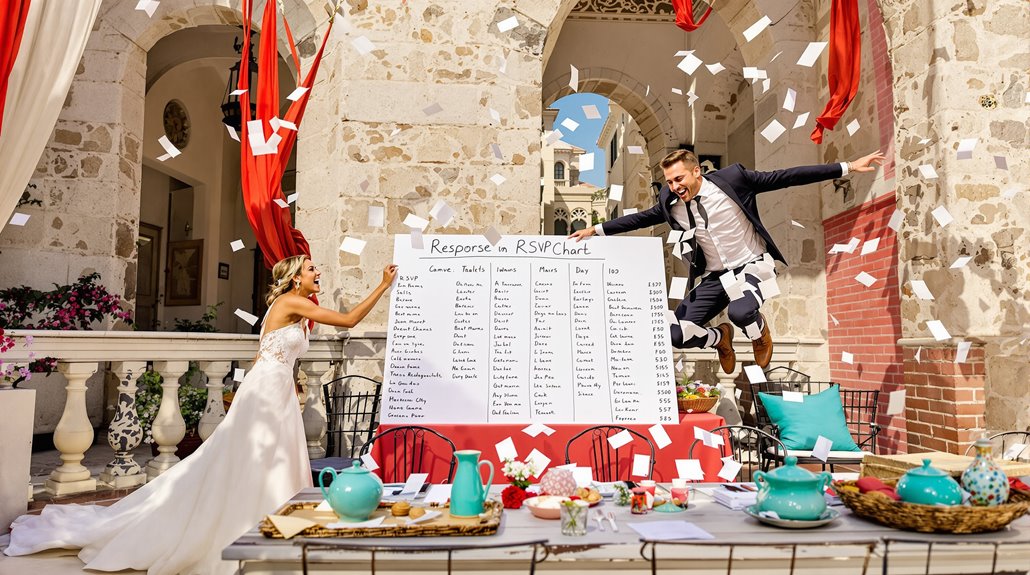
When you’re staring down the barrel of a wedding RSVP list, you need a streamlined action plan that gets the job done faster than you can say, “I do.” This isn’t a stroll in a rose garden; it’s a high-stakes game of RSVP roulette where the odds favor those who plan with laser precision. Here’s your page action plan:
A high-stakes RSVP game demands precision planning for wedding success.
- Send invites 6-10 weeks before the big day—3-4 months for formal affairs.
- Set the RSVP deadline three weeks pre-wedding—non-negotiable.
- Expect 80% to say “yes” and plan for 75-85% attendance.
- Use metrics: Week 3 is peak response time—13% of RSVPs roll in.
- Screenshot this plan, stick to it, and pivot if responses slow post-Week 5.
Remember, decision-making dynamics like who gets final say can impact how quickly you get those RSVPs back, so coordinate clearly with your planning team.
Now, execute it like a pro.
FAQ
Got a unique situation that doesn’t fit the mold? First, grab that checklist and start setting your RSVP timeline—it’s your non-negotiable starting point. Regret usually comes from moving too fast, so watch for red flags like rushed vendor choices; if you’re adding or removing vendors, adjust timelines to keep everything streamlined and executed without a hitch. For more clarity, consider how stakeholder governance milestones can help clarify roles and approval processes when managing your RSVP deadlines.
What if my situation doesn’t match the examples?
If your wedding setup feels more like a high-stakes boardroom than a traditional garden soirée, you’re not alone. In this kinetic journey, strategic planning is your best ally. Let’s get real: timelines aren’t one-size-fits-all. If your situation doesn’t match the standard 6-10 week timeline, pivot to what works for you. Consider factors like destination logistics or high-demand venues that need iron-clad numbers early. Accelerate RSVP collection by offering digital responses and strategic nudges. Keep a buffer for last-minute pivots—unexpected declines can derail plans if not managed. Prioritize vendor deadlines and maintain consistent communication. The non-negotiable? Execution over aesthetics. Now, grab your checklist, streamline those tasks, and get moving—chaos managed is chaos conquered.
What’s the first thing I should do today?
Let’s cut straight to the chase. First thing today, nail your RSVP strategy. Invitations go out 6-8 weeks before the wedding, so if you’re in that window, it’s go-time. For destination weddings, accelerate—send them 3-6 months early. Set your RSVP deadline 3-4 weeks before the big day. This isn’t just for kicks; you need a final headcount 1-2 weeks before the wedding. To keep things moving, remind guests 1 week before their RSVP is due and follow up with any slackers 1-2 weeks after. Use tech—QR codes, websites, apps—for streamlined responses. Keep it clear: “Kindly reply by [date]” should scream from the page. Today’s action: draft your invite timeline. You’ve got this.
What’s the most common regret?
When it comes to wedding planning, regrets stack up faster than you can say “I do.” The most common regret? Feeling rushed. You might be used to executing projects with precision, but weddings have a knack for spiraling into chaos. Nearly 60% of couples spend over four months planning, yet rushing through the wedding day turns it into a blur. Guest lists? Another slippery slope. Many regret inviting too many people, caving to tradition rather than personal preference. And don’t even get started on those vendor choices—30% of brides wish they’d hired a better photographer. Your move? Strategically streamline your timeline and choices. Focus on quality over quantity. Trust us, clarity trumps chaos. Next step: create a non-negotiable checklist.
What’s a red flag that I’m moving too fast?
Ever feel like your wedding planning is more of a marathon sprint than a carefully orchestrated waltz? If so, you might be moving too fast. Sending invitations fewer than six weeks before your wedding day is a major red flag. This rush gives guests little time to plan, and you end up in a logistical nightmare. Destination weddings especially demand more lead time—think 10-12 weeks for proper guest prep. Setting an RSVP deadline fewer than 3-4 weeks ahead complicates vendor coordination, potentially leaving you with last-minute chaos. Use multiple RSVP methods to boost response rates. Remember, strategic timelines aren’t just a suggestion; they’re non-negotiable. Need a game plan? Start by building a timeline that respects everyone’s schedule.
What changes if I add/remove vendors?
Adding or removing vendors from your wedding mix is like adjusting the gears on a high-speed bike—it can accelerate your planning or throw you off balance. Each vendor affects timelines and logistics. More vendors? That’s more coordination, more deadlines, and yes, more emails. Fewer vendors? Streamlined communication but expect to pivot if tasks overlap.
With RSVP deadlines, vendor changes impact headcounts and seating arrangements—critical for caterers and event ticketing. Lock in RSVPs 3-4 weeks before to give vendors ample time for adjustments. Remember, every vendor shift ripples through your timeline. Keep a vendor checklist and update it with every change. Anticipate the unexpected and embrace the chaos—because it’s all part of the hustle. Stay sharp, stay strategic, and stay on schedule.
Key takeaways
Let’s cut to the chase—getting those RSVPs back on time is like herding cats. But hey, who’s got time for cat-wrangling when you’re planning a wedding with military precision? Here’s how you can streamline the process:
- Strategic Timing: Send invitations 6-10 weeks before the big day; aim for 10 weeks if your guests need to book flights.
- Deadline Discipline: Set your RSVP deadline three weeks before the wedding. This allows you to pivot if plans change.
- Vendor Alignment: Sync RSVP deadlines with vendor requirements to avoid last-minute chaos.
- Realistic Expectations: Anticipate 75-85% attendance. Out-of-town folks might not make it, so plan accordingly.
Reality Check: Prioritize communication. Early and clear invites guarantee a smoother, more controlled RSVP process.