
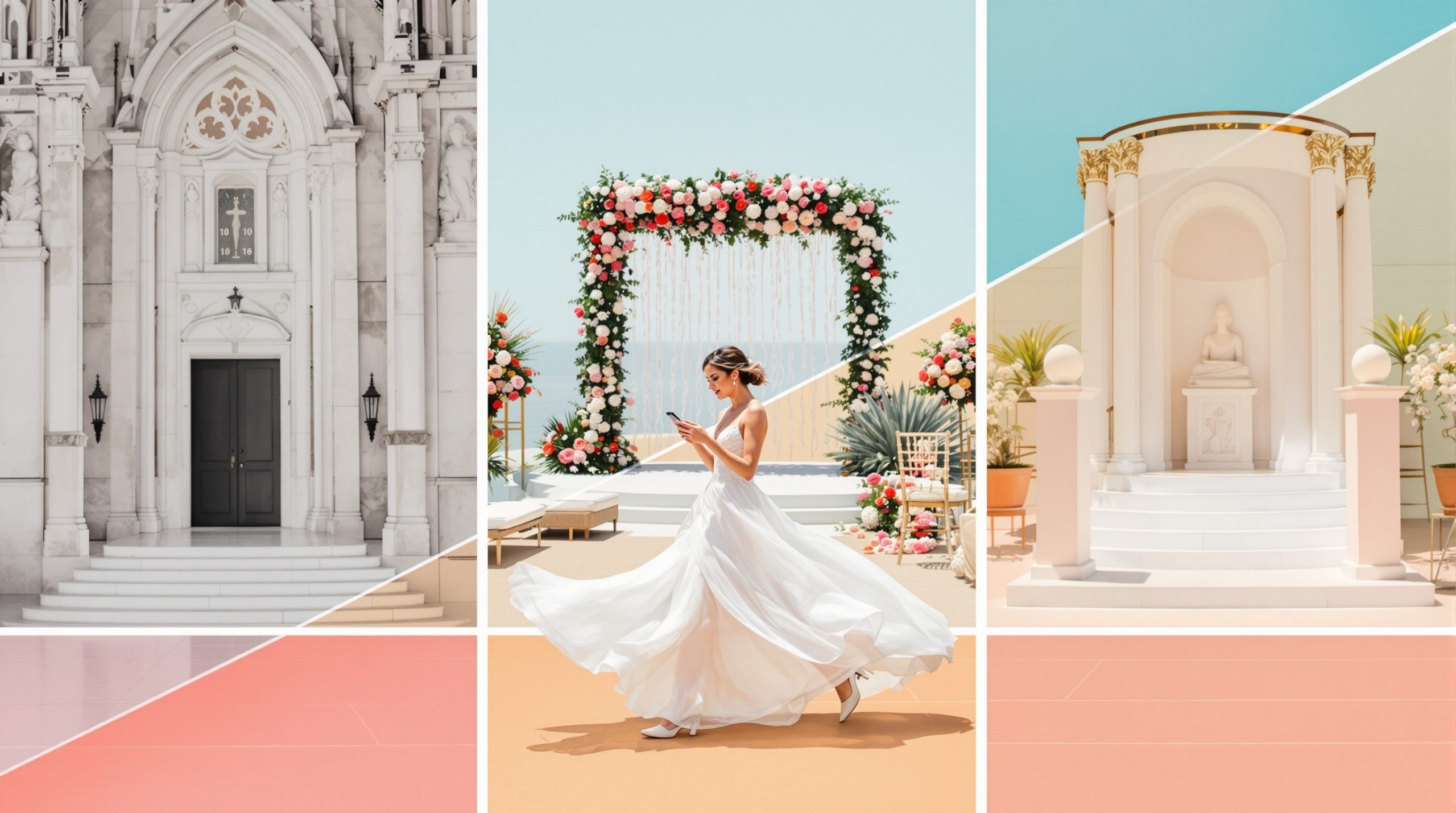
Planning a wedding ceremony? Strategically nail down the length: religious types usually run up to 60 minutes with all the rites (bless-and-stress, much?), while secular and spiritual ceremonies are executed in a streamlined 20-30 minute window—non-negotiable for our efficiency-loving audience. We’re talking precision-driven timelines where every minute counts. Unless you fancy snail-paced vows, there’s no reason to delay partying. Wondering what else to reflect on for your ceremony? Let’s set the pace right.
Quick verdict: Religious vs. Secular vs. Spiritual (who each is best for)
When it comes to wedding ceremonies, it’s all about nailing the right vibe for you and your partner—without wasting a single second. Let’s explore the ceremony type comparison to see what fits your fast-paced lifestyle.
- Religious: Perfect for couples who prioritize faith and want clergy blessings. This option provides a structured timeline, like a 25-30 minute Catholic mass. It’s all about tradition and spiritual support.
- Secular: If you’re all about freedom and customizing every detail, this one’s for you. No spiritual elements, just pure focus on your unique love story—efficient and inclusive. Tailor the ceremony to fit your vision and discuss priorities for a truly personalized experience.
- Spiritual: This blends personal beliefs with flexible sacred elements. Ideal for those acknowledging a higher power without strict religious ties.
Strategically streamline your ceremony choice and keep hustling forward!
At-a-glance comparison: Religious vs. Secular vs. Spiritual
Considering the ceremony type at a glance, you want a quick, efficient decision that aligns with your laser-focused lifestyle. Let’s break down the ceremony style options, so you can pivot your planning game like a pro.
| Ceremony Type | Typical Duration |
|---|---|
| Religious | 25-30 minutes |
| Secular | 20-30 minutes |
| Spiritual | 20-30 minutes |
Religious ceremonies are structured and standardized. Secular ceremonies are formulaic but swift, perfect for those who operate on tight schedules. Spiritual ceremonies offer customization with the same streamlined timeframe. Each type has its non-negotiable elements, but it’s about choosing what strategically meets your needs. Personal beliefs and cultural backgrounds are key factors in deciding the type of ceremony that will best represent you and your partner. Accelerate your planning by aligning your ceremony choice with your lifestyle. Ready to move forward? Let’s execute this with precision.
Define the options (so you’re comparing the right things)
When you compare ceremony types, it’s crucial to know what you’re really dealing with. Religious ceremonies, for example, aren’t just about tradition—they often include rites like communion that add time, while secular ceremonies strip things down, focusing on what gets the job done in a streamlined way. Spiritual ceremonies, on the other hand, blend rituals and personalization, but watch out for misconceptions that they take forever; they’re about meaningful moments, not marathon sessions. It’s important to remember that full Catholic masses can exceed 60 minutes, making them among the longer religious ceremonies.
Religious: what it is, what it includes, and the common misconceptions
Let’s cut to the chase: religious ceremonies aren’t just for the big rites of passage—they’re a masterclass in tradition, executed with precision and deep meaning. They’re strategic, blending prayers, readings, songs, and symbols in a structured sequence. Think of them as a project plan for honoring a deity, packed with rites of passage, seasonal celebrations, and ritual actions like bowing and kneeling. Here’s the kicker: they’re not always big public spectacles. Sometimes they’re personal or even secretive. And, believe it or not, animals have their own versions. People often think these ceremonies are emotionally charged or uniform across faiths. Wrong. They vary widely and work on a different level—connecting you to community, history, and the divine. Rituals reflect cultural and social structures within communities, contributing to our understanding of human behavior and belief systems. Ready to pivot your perception?
Secular: what it is, what it includes, and the common misconceptions
Whether you’re ditching the dogma or just want a ceremony that screams “you,” secular ceremonies are your go-to for streamlined, hyper-personal celebrations. Forget the stained-glass expectations—this is your stage, and you’re the star. Secular ceremonies pivot on personalization, featuring your life story, custom vows, and even symbolic rituals like unity candles or sand blending. Toss in some poignant poems or movie quotes for good measure. You get full creative control—who’s involved, what’s read, and how it’s all executed. No rigid rules here; it’s your vision, your way. Common misconceptions? People think they’re cold or lack depth. Not true. They can be as emotional or humorous as you want. Ready to plan? Start with a checklist to streamline your vision. A secular ceremony can be organized in various locations based on guest count and ceremony type, offering flexibility in venue choice. Consider using a Decision-Priority Map to rank your must-haves and allocate your budget effectively right from the start.
Spiritual: what it is, what it includes, and the common misconceptions
Although spiritual ceremonies might seem like just another kind of religious gathering, they pivot on personal connection rather than prescribed doctrines. Think of them as strategically tailored rituals that emphasize your bond with the universe, not rigid rules. They’re executed with symbolic tools like fire, water, or herbs to foster transformation and unity. Sacred ceremonies can be performed in solitude or with a group and serve as a means of spiritual expression and growth. Expect thorough yet streamlined components: invoking divine forces, purifying energy, and setting intentions with offerings like flowers or herbs. Forget communal festivity; these are intimate, often solitary, experiences. Unlike chaotic misconceptions, they follow specific sequences and allow for spontaneity.
Don’t mistake them for outdated relics; they’re relevant and purposeful, even in today’s fast-paced world. Ready to incorporate spirituality without religious constraints? Start by identifying your personal intentions and sacred elements—then watch the magic unfold.
Cost breakdown (upfront vs hidden costs)
When you’re mapping out ceremony costs, it’s essential to strategically differentiate between upfront expenses and those sneaky hidden fees that creep in later. Think of it like a budget bouncer: upfront costs are the cover charge, while hidden fees are the surprise coat check or pricey bottled water. Use a detailed checklist to keep these in check and guarantee your ceremony gets executed without financial whiplash. Venue rental fee often constitutes the largest expense, especially for small church weddings, and can significantly impact the overall budget. Remember that taxes and service charges can increase your budget by 10-15%, so plan accordingly to avoid unexpected surprises.
Line-item cost comparison by tier/budget
Let’s break down the dollars and sense of wedding ceremonies—because wasting time isn’t in your vocabulary. You want numbers, not fluff, so here’s a quick glance:
| Budget Tier | Key Costs |
|---|---|
| Ultra-Low Cost Ceremonies | Licenses $30-$100, Officiant $200-$1,000 |
| Small Church Weddings | Venue $500-$3,000, Supplies $30-$100, Bell $100+ |
| Mid-Range Religious | Site $2,311-$2,966, Music $761-$1,249, Dress $3-$100 |
| Premium Secular/Spiritual | Officiant $240, Photographer $2,630-$2,900, Videographer $1,912-$2,300 |
Execute your ceremony plan with precision by strategically budgeting your non-negotiables. Hidden costs like planner fees and officiant travel can sneak up, so stay sharp. It’s important to note that while the average cost of a wedding in 2017 was $33,391, high spenders often went significantly over budget, averaging an excess of $20,417. Remember to allocate a 10–15% contingency buffer to cover unexpected costs and ensure a stress-free planning process. Ready to accelerate your wedding planning? Draft a checklist to streamline your budget priorities.
What actually drives cost changes
You know the deal: it’s a wedding, not a financial black hole. Yet, costs can sneak up on you faster than you can say “I do.” To keep your budget grounded, focus on these:
- Upfront Venue Costs: Your venue choice isn’t just a backdrop; it’s a budget beast, eating up around 17% of your total spend. Regional differences mean your venue in Manhattan might cost over three times more than one in Utah.
- Catering and Beverage Expenses: Food and drink can gulp 40-45% of your budget. Watch out for hidden service charges that inflate costs.
- Photography and Videography: These capture memories, but their costs capture your budget’s attention, representing a solid mid-tier expense.
Remember that destination weddings can add an additional $6,700–$8,700 to your overall expenses, highlighting the importance of accounting for these supplementary costs.
Reality check: Hidden fees are lurking—identify them early to pivot wisely.
Planning workload & logistics impact
In the fast-paced world of wedding planning, ceremony length isn’t just a time slot—it’s a strategic decision that impacts your planning workload and logistics. Religious ceremonies often mean juggling institutional rules and tighter vendor coordination, while secular options simplify content but trip you up with scheduling rigidity. With spiritual ceremonies, you’ve got the freedom to craft a unique experience, but that means higher complexity and more coordination with celebrants; nail down vendor flexibility early to keep the chaos controlled. A well-planned wedding can be managed effectively by establishing a wedding budget and leveraging strategic planning to ensure all elements align with the couple’s vision.
Time, complexity, and coordination differences
When mapping out your wedding, understanding the time, complexity, and coordination differences is essential to executing a day that moves as efficiently as your career does. It’s all about strategically managing what’s on your plate.
- Time Efficiency: Secular ceremonies typically run 15-20 minutes, ideal for those who want to accelerate into the celebration. Meanwhile, religious ceremonies like a Muslim Nikah or a full Catholic Mass can extend up to 40 minutes, demanding more logistical finesse.
- Complexity Levels: Secular weddings cut through the fluff, focusing solely on your commitment, while religious ones weave in traditional rites, adding layers of complexity.
- Coordination Needs: Secular setups mean less coordination—often just the officiant and witnesses. Religious ceremonies mean syncing with leaders, rituals, and family dynamics.
In addition, recognizing the importance of vendor management can significantly ease the planning process, ensuring all elements align seamlessly with your wedding vision.
Next steps? Prioritize what’s non-negotiable for you.
Vendor availability + flexibility considerations
Though it might seem like vendor availability is just another checkbox on your wedding planning list, it’s actually a high-stakes game of strategy—think chess, not checkers. Your vendors can make or break your smooth, stylish event, especially when juggling religious, secular, or spiritual themes. Here’s how to keep everything moving:
- Strategically Align: Book your venue first—82% do it that way—to dictate style and streamline decisions.
- Flexibility Wins: Use planning apps for quick comparisons; 64% of couples swear by them for secular events.
- Plan for Specifics: Hire specialized planners for interfaith or multi-day religious ceremonies to lighten your load.
Reality Check: Exceeding budgets is a common pitfall—53% fall into this trap. Prioritize and execute like a pro.
Additionally, venue capacity is a crucial consideration when planning your wedding; it not only impacts budget but also determines guest list size and event comfort.
Guest experience impact
You know the drill: guests want a ceremony that respects their time without feeling like they’re stuck in a never-ending meeting. When ceremonies stretch beyond 30 minutes, patience thins, and even the best intentions can’t stop the fidgets. Keep it tight and impactful, and your guests will thank you with enthusiasm on the dance floor instead of yawns during the vows.
How guests perceive it + where friction shows up
Guest experience is often the unsung hero—or villain—of your wedding ceremony. How your guests perceive the ceremony length can make or break their mood. Let’s break it down:
- Short and Sweet: A 20-25 minute ceremony is your golden ticket. It shares your love story without sending guests into a daydream daze.
- Tradition vs. Tedium: Religious ceremonies can drag for guests unfamiliar with rituals, testing patience. Catholic ceremonies, sans mass, can still feel lengthy for non-believers.
- Inclusivity or Bust: Non-religious ceremonies win by embracing diverse beliefs, but civil ceremonies might feel sterile to those craving emotional depth.
Reality Check: Don’t get caught up in tradition if it alienates your audience. Execute a ceremony that keeps guests engaged and comfortable.
Best-fit scenarios (choose based on constraints)
You’re juggling timelines, and ceremony length is your next strategic move. Opt for a religious ceremony if traditions are non-negotiable and you’ve got time to spare. Secular ceremonies get the job done quickly, perfect for when the clock’s your enemy, while spiritual ceremonies offer a customized blend that balances meaning with your schedule.
Choose Religious if…
When tradition isn’t just a box to check but a deeply rooted part of your identity, a religious ceremony might be your non-negotiable. If you’re strategically planning a wedding and faith elements are vital, here’s when a religious ceremony gets the job done:
- Cultural Significance: If your ceremony’s cultural rituals are non-negotiable, religious ceremonies embrace those deeply meaningful traditions.
- Intentional Depth: If you prioritize rich, spiritual experiences over the quick fix, these ceremonies provide the depth you crave.
- Family Expectations: Sometimes, it’s about honoring family ties—religious ceremonies often align with those expectations.
Additionally, research on marriage from the American Psychological Association suggests that shared religious beliefs can enhance marital satisfaction and stability.
Now, streamline the planning by syncing with your officiant to nail down timelines and logistics. Use checklists to guarantee smooth execution and pivot efficiently if needed.
Choose Secular if…
If you’re looking to execute a wedding ceremony with precision and speed, a secular approach might just be your best ally. It’s ideal for those who value brevity and clarity over fluff, efficiently fitting within a 20–30 minute window. Here’s where it shines:
- Short Timeline Constraints: Civil ceremonies clock in at 15–20 minutes, perfect for venues with tight schedules.
- Small Guest Lists: Fewer attendees streamline the processional, reducing ceremony time to keep your Type-A guests engaged.
- Minimal Customization: A straightforward format—2-minute processional, 6-minute vows, 1-minute pronouncement—keeps it short and sweet.
Execute strategically, with laser focus and no room for stress-induced chaos. Remember: simplicity is non-negotiable. Next up? Organize that killer cocktail hour.
Choose Spiritual if…
Opt for a spiritual ceremony if you’re all about creating a personal vibe without the heavy baggage of religious protocol. This approach is perfect for the no-nonsense couple who values time efficiency and flexibility.
- Customizable Content: You get to choose the meaningful elements—personal vows, special readings—without rigid religious structures dictating the flow.
- Streamlined Execution: With a typical 15-30 minute duration, it’s all about keeping things moving smoothly and keeping guests engaged.
- Modern Scheduling: The short format fits perfectly into tight timelines, reducing stress on you and your vendors.
A spiritual ceremony is your go-to for a concise, personalized experience. Ready to streamline? Start by listing your must-have elements and ditch the rest. That’s how you hustle smart. Additionally, consider establishing a clear budget with specified constraints to ensure the ceremony remains within your financial means while allowing for customization.
Real-world scenarios (examples with numbers)
You’ve got a 150-guest list, a $30K budget, and a no-fuss approach to rituals? Let’s execute a streamlined ceremony that maximizes impact without dragging on. For a 30-minute affair, focus on a secular service that strategically balances personal vows with efficiency, ensuring your priorities get the spotlight and your guests stay engaged.
3 sample scenarios: guest count + budget + priorities
Maneuvering the maze of wedding planning doesn’t mean sacrificing your sanity or your paycheck. With the right approach, you can strategically execute a ceremony that respects your priorities and budget. Here’s a snapshot of different scenarios to evaluate:
| Guests | Budget | Priority |
|---|---|---|
| 50 | $5K | Time Efficiency |
| 100 | $15K | Legal Simplicity |
| 150 | $25K | Personalization |
For 50 guests, a civil ceremony gets the job done in 10-15 minutes, aligning with a tight $5K budget. Scale up to 100 guests with a $15K budget, and a courthouse wedding moves quickly, saving time and money. For 150 guests, personalization gains momentum with a $25K budget, allowing for custom vows and flexible venues. Venue and catering typically consume over half of the total wedding budget, so it’s crucial to prioritize these elements effectively. Next steps? Draft your non-negotiables and streamline decision-making.
Common mistakes (and how to avoid them)
Let’s cut to the chase: misjudging ceremony lengths is like trying to squeeze a marathon into a sprint—it doesn’t end well. Here’s how to dodge the common pitfalls:
- Underestimate Guest Involvement: Communion for a large crowd can extend beyond expectations. Strategically plan for 45 minutes if you’ve got 250 guests without additional ministers. Don’t let surprise logistics derail your timeline.
- Overlook Secular Norms: Civil ceremonies are concise. Aim for 15-20 minutes max. Exceeding this risks audience attention. Execute with precision and keep it tight.
- Ignore Spiritual Variations: Custom vows or cultural rituals? These add time. Balance tradition with pacing by communicating with your officiant. A 30-minute buffer is non-negotiable.
Reality Check: Efficiency isn’t an option—it’s a necessity. Strategically plan, pivot when needed, and accelerate your ceremony timeline.
Copy/paste decision matrix template

When it comes to deciding on the perfect ceremony length, a decision matrix is your secret weapon—think of it as your wedding planning Swiss Army knife. You’re juggling a career, a wedding, and a life, so don’t waste time guessing. Lay out your options: religious, secular, spiritual, and nondenominational. Each ceremony type has its own rhythm—religious ones often stretch longer due to rituals, while secular ceremonies streamline down to essentials. Use a matrix to strategically compare these formats on factors like length, personalization, and guest engagement. This isn’t just a chart; it’s your blueprint for executing a ceremony that honors your story without dragging on. Make your decision actionable—plot your priorities, and pivot to what gets the job done efficiently.
FAQ (quick answers to common edge cases)
Stuck between two options? Focus on a streamlined fallback plan that moves you forward, not backward, by confirming vendor assumptions and strategically managing guest count shifts. If chaos strikes, pivot with confidence using a pre-executed checklist that gets the job done without missing a beat.
What if I’m stuck between two options?
How do you efficiently decide between two ceremony options without losing your sanity? First, let’s pivot from indecision to action. Create a pros and cons list for each option, focusing on engagement, duration, and guest comfort. Consider a hybrid approach, mixing religious and secular elements, executed within a 30-45 minute sweet spot. Communicate with your officiant about prioritizing rituals and time allocation. Don’t forget guest demographics and venue logistics—shorter ceremonies keep guests energized and ready for the reception. Use tools like timelines and checklists to streamline planning. Remember, this isn’t about Pinterest perfection; it’s about what gets the job done. Ready to move? Strategically choose what respects your hustle and meets your expectations. Next, set a realistic timeline with your planner.
What’s the easiest way to reduce risk with either option?
Let’s talk risk reduction. You want to keep your ceremony efficient without sacrificing the essentials. The fastest way? Trim the fluff. Ditch the live music and symbolic rituals—streamline to vows, rings, and that first kiss. This gets you a crisp 15-20 minutes. Opt for an experienced officiant who can hit that timeline with a 5-minute buffer for any hiccups. Don’t let speeches and guest participations hijack your schedule; limit them to maintain momentum. Look, you’re not managing a Broadway show, so skip the overblown theatrics. Keep it simple, impactful, and under control. Need more insurance? Plan for a one-hour margin to handle delays without stressing your guests. This strategic approach keeps things tight and your event on track.
What should I ask vendors to confirm assumptions?
Why sweat over ceremony length? Because knowing the ins and outs guarantees your wedding timeline runs like a well-oiled machine. Start by confirming if your venue’s 30-minute allocation covers the entire processional, ceremony, and recessional combo. Check if the officiant’s speaking pace fits your timeline—speedy or leisurely matters. Ask about any technical limitations that could extend the ceremony unexpectedly. Verify if there’s a hard stop on ceremony completion, especially when reception setups follow. For religious ceremonies, confirm specific durations—Catholic, Jewish, or Hindu traditions have distinct timeframes. With secular ceremonies, guarantee the 15-20 minute average fits your vision. Don’t forget to clarify the time for vows, rituals, and music. Nail these details, and watch your wedding day flow seamlessly.
What changes if my guest count swings by 20%?
When your guest list swings by 20%, it’s not just numbers—it’s an operational pivot. You’ll need to adjust your timeline with precision. A larger processional means a 2-5 minute extension for the wedding party’s grand entrance. Family photos? Tack on 10-15 extra minutes. But here’s the kicker: your core ceremony remains rock-solid at 10-30 minutes, no matter the headcount. Why? Because vows don’t scale with guests. Venue logistics adapt smoothly for medium-sized events, but seating setup might add a pre-ceremony hustle of 5-10 minutes. Use this shift to refine your photo and video timelines—strategically. Reality Check: A 20% swing means recalibrating RSVPs and budget, not ceremony length. Keep your eye on execution, not distraction.
What’s the best fallback plan if something goes wrong?
Even in the sleekest operations, glitches happen, but that’s where your fallback plan kicks in like a well-oiled machine. First, secure a venue with flexible indoor/outdoor spaces to pivot smoothly if weather or capacity shifts. Vendor no-show? Have backup vendors on speed dial, and lock everything down with written agreements and wedding insurance. A wardrobe snag is no match for your disaster kit stocked with essentials like Shout wipes and safety pins. Check the weather forecast and have umbrellas or indoor options ready to move. Logistics are your best friend: create a detailed timeline and emergency contact list. Finally, designate a trusted person to handle rings and vows. Your smart planning turns chaos into seamless execution.
Next steps: make the decision + execute the plan
Once you’ve navigated the sea of ceremony options, it’s time to make a decision and execute your plan with pinpoint precision. You’re not just organizing a wedding; you’re engineering a seamless event. Here’s how to accelerate your planning:
- Religious: Secure your clergy and complete any prep classes. Stick to faith-specific elements within the 20–60+ minutes range. Don’t forget your marriage license—it’s non-negotiable.
- Secular: Book a judge or celebrant for a swift, 10–25 minute affair. Personalize your vows but keep them legally sound. A courthouse or outdoor setting gets the job done.
- Spiritual: Choose a secular celebrant for a 20–30 minute ceremony. Infuse cultural rituals like handfasting, ensuring the marriage license is handled separately.
Reality Check: Forgetting legal requirements can derail the celebration—double-check everything!