

Set those RSVP deadlines earlier! It’s less about cute tablescapes and more about running a tight ship. You need to get ahead of vendor deadlines and guest procrastination. Think of it as project management with a side of FOMO-inducing hustle. That means cutting out the, “Will they? Won’t they?” nightmares and paving a clear path to your big day. Get those invitations out and lock it down. When it comes to smooth execution, time isn’t on your side. Want more insights?
The thesis (what people get wrong)
When it comes to RSVPs, most people get it all wrong by assuming they can push deadlines closer to the big day. Let’s pivot from that common mistake and execute a smarter RSVP deadline strategy. You need to embrace deadline planning like a boss. Realistic RSVP timing means setting your deadline at least 10 days before vendors need headcounts, not a week prior. This buffer allows you to chase those dawdlers without breaking a sweat. Local weddings thrive on invites sent 6-8 weeks ahead, with RSVPs due 3-4 weeks before. This isn’t just good planning—it’s non-negotiable precision. Accelerate your response rates with strategic reminders, because in wedding planning, time moves fast and doesn’t forgive. Keep in mind that hidden costs can pile up quickly if your guest count changes late in the process, potentially impacting your overall budget and vendor contracts. Prioritize invitees who have shown genuine interest in past events and respect opt-outs gathered through unsubscribe functions. Ready to streamline your guest list? Let’s hustle.
Why this happens (the real root causes)
While you might think RSVPs are straightforward, they’re often a hidden pitfall in wedding planning—one that can derail your timeline faster than you can say “I do.” Procrastination isn’t just a guest habit; it’s an art form that requires you to set earlier deadlines as a buffer against last-minute chaos. Why does this happen?
- Guest Procrastination: People wait until the eleventh hour, secretly testing your patience. Setting an earlier RSVP buffer time guarantees you’re not chasing responses at the last minute.
- Vendor Requirements: Caterers and venues demand headcounts weeks ahead. Early RSVPs align with these non-negotiable needs.
- Invitation Delays: With traditional mail, delays are inevitable. Factor in extra time for international guests and post-pandemic hiccups.
Strategically planning this buffer accelerates your wedding planning success. Sending formal wedding invitations 2-4 months before the wedding date ensures ample time to accommodate these factors.
What to do instead (the better framework)
Let’s be real: RSVPs are the Achilles’ heel of wedding planning, but mastering them can catapult your event into the domain of legendary execution. You need a framework that’s as streamlined as your morning routine. Here’s how you execute it:
- Send Save-the-Dates Early: Gauge interest with a simple form. Include an “Add to Calendar” feature to boost attendance. RSVP cards finalize wedding plans and ensure accuracy, so sending them in advance helps in planning other aspects like catering and seating.
- Set Early RSVP Deadlines: Create urgency by setting deadlines 5-7 days before the actual cutoff. This gives you buffer time and keeps your planning on track.
- Use Clear and Urgent Wording: Cut the fluff—be specific. Say, “Please RSVP by [Date] via our wedding website.” Clarity boosts response rates.
Now, pivot and keep those RSVPs rolling in!
How to apply it in real life
Envision this: you’re juggling a full-time career and planning your wedding. You strategically set your RSVP deadline 3 weeks before the event, giving vendors the headcount they need while respecting your guests’ busy schedules. In a high-stakes scenario, like a destination wedding, execute an early save-the-date, then pivot to a smartly timed follow-up, ensuring you maximize guest attendance without losing your sanity. Remember, destination weddings attract only 50% to 70% of invited guests, so setting an earlier RSVP deadline can help you manage expectations and plan accordingly. Setting a firm RSVP deadline also helps you manage guest list dynamics and gives you a buffer for last-minute changes without impacting your budget or vendor commitments.
Example 1: a common scenario + the better move
Managing RSVPs for events can feel like herding cats, but with strategic planning, you can turn chaos into order. Let’s tackle a common scenario: a casual gathering. You’ve sent invites two weeks ahead, but responses trickle in like molasses. The better move? Set your RSVP deadline a week before the event. This gives you precious time to pivot—invite more guests if needed or adjust your setup strategy. Your vendors demand headcounts weeks in advance, so work backward from their deadlines. In fact, when planning larger gatherings like weddings, it’s crucial to understand how venue minimum spend requirements can affect your final guest count and budget. Highlight RSVP dates boldly on invitations—think “RSVP by June 25” in neon lights. Employ mobile-friendly forms for quick responses and personalize invites for engagement. Automate reminders post-deadline to wrangle those last-minute stragglers. To make things easier, utilize platforms like zkipster for easy RSVP tracking and management. Ready to execute like a pro? Go get it.
Example 2: a high-stakes scenario + the better move
When orchestrating a high-stakes affair like a destination wedding, the RSVP deadline isn’t just a date—it’s your lifeline. You need precision to manage caterers, venues, and travel logistics. Set that RSVP 6-8 weeks before the big day—trust us, it’s non-negotiable. Work backwards from your caterer’s deadline. If they need numbers by December 26th, demand RSVPs by December 15th. This strategic move gives you a week to chase down stragglers—because you know they’ll be there. Plus, it’s your time to lock in seating charts and special meals. Use urgency: “Seats are limited” gets the job done. Always send reminders; automate them if you must. Schedule reminders in advance to avoid last-minute stress. Planning ahead like this helps you avoid decision fatigue and keeps the process smooth for everyone. Here’s your hustle: invite 10-12 months ahead, and keep those timelines tight.
Example 3: a ‘we’re busy’ scenario + the better move
Let’s face it—you and your partner are the poster children for a ‘we’re busy’ scenario, juggling career moves, maybe a relocation, and a wedding that’s looming faster than a Monday morning meeting. You need efficiency, not chaos, so set that RSVP deadline 7 months out—non-negotiable. This strategic move isn’t just about keeping you sane; it’s about precision. Nearly 70% of couples use digital save the dates for weddings, which can streamline communication and help manage responses more effectively. Lock in those vendor commitments early for better rates and terms. Streamline your guest communication—employed guests appreciate the heads-up for time-off requests. Plus, you’ll have time for organized follow-ups with stragglers. Relying on printable timeline + tracker resources helps avoid timeline overload and keeps you and your vendors in sync. It’s all about executing this like a well-oiled machine. Next step: craft a killer checklist to track RSVPs and vendor timelines. This isn’t just planning; it’s smart project management.
Counterpoints (when the old way is actually fine)
Even though the hustle culture mindset favors innovation and speed, there are moments when sticking to the old ways can be surprisingly effective. Consider the traditional RSVP timeline—it’s a classic for a reason. Here’s why it can still work:
- Alignment with Vendors: Traditional deadlines align seamlessly with vendor needs, preventing last-minute chaos. You get headcounts without breaking a sweat. Adding buffer time, as recommended by wedding planning experts, can make even traditional timelines more stress-free.
- Guest Convenience: Shorter lead times prevent guests from forgetting the event, ensuring higher response rates. It’s about striking the right balance.
- Proven Track Record: Standard practices exist because they work. They effectively streamline the planning process, reducing stress and saving time. Save-the-dates and RSVP requests should be treated as a unified system, where the initial save-the-date builds anticipation for the event and provides guests with time to adjust schedules, especially for travel.
In a world that demands speed, sometimes the tried-and-true method gets the job done with precision and reliability.
Action plan (do this next)
To keep your wedding planning on track without the fluff, it’s time to shift from traditional timelines to an action plan that gets results. You’ve got a wedding to execute, not a dream board to build. Let’s move:
- Set Early Deadlines: Align RSVP deadlines 10 days before vendor needs. No one’s got time for last-minute chaos—extra invites await if numbers fall short.
- Streamline Invitations: Send them 3-4 weeks before the RSVP cut-off. Consider this your strategic strike—timely invites mean timely returns.
- Simplify Responses: Use online RSVPs for instant feedback. Offer options, but make it foolproof. Confusion isn’t on the guest list.
Remember, guest count accuracy is key, as it directly affects your venue, catering, and overall budget allocations.
Reality Check: Forget the fluff. Early RSVPs = smart planning. Pivot early, save sanity later.
Visual summary you can share
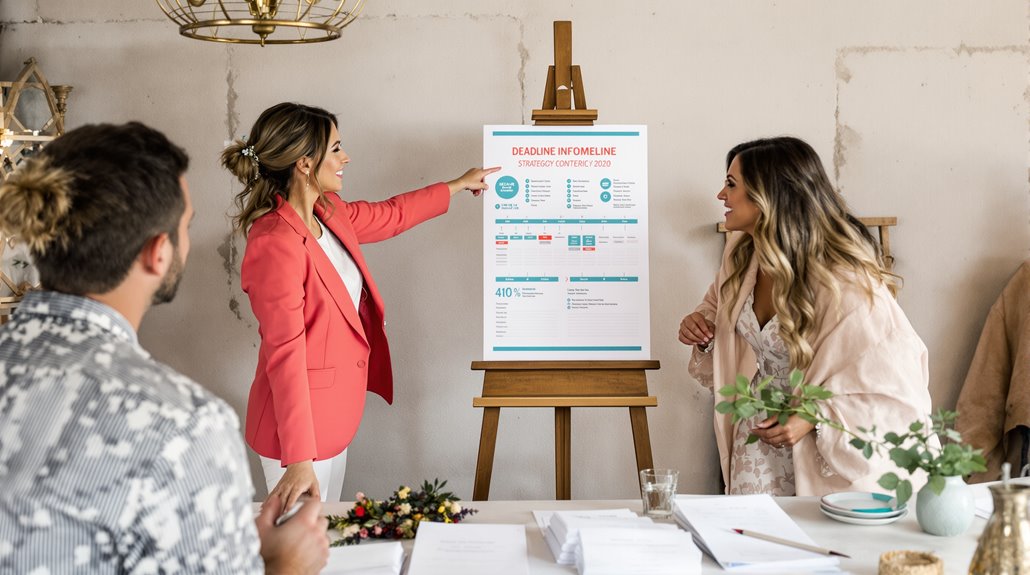
Envision this: You’ve got a wedding to execute, not some fairy tale to fantasize about. To streamline success, create a visual summary that distills RSVP deadlines in kinetic precision. Picture a sharp infographic that states: invites sent 3-4 months ahead, with a 1-month response window. Highlight non-negotiable vendor needs—caterers, venues—demonstrating why RSVPs close 1-2 weeks before their cutoffs. Use bold timelines, bullet points, and banners—no fluff, just facts. {img} Suggestion: An infographic showing event timelines, invite send dates, and deadlines, with arrows and checkboxes. {save_text} RSVP_Infographic.png.
Accelerate clarity with a deadline banner: “RSVP by June 25.” Leverage reminders—1 week, 1 day pre-deadline—so no one’s guessing. What gets tracked, gets done. Next step: Share this tool with your VIPs. For best results, align your RSVP deadlines with strategic execution principles so that vendor management and event logistics stay efficient from start to finish.
FAQ
You’ve got questions, and we’re all about getting you answers, fast. If family or vendors are throwing wrenches into your plans, it’s time to pivot with authority and bring the focus back to your strategic timeline. Whether you’re second-guessing a decision or need your partner on board, we’ve got quick wins and course-corrections that get the job done, so let’s execute them with precision.
What if my family/vendors push back?
When family or vendors start pushing back, it’s time to pivot into project management mode—because, honestly, this isn’t your first rodeo. Remind them that deadlines aren’t arbitrary; they’re strategically set to meet vendor requirements and guarantee a seamless execution. Caterers and venues have non-negotiable timelines—4-6 weeks and 2-4 weeks pre-wedding, respectively. Use this data to support your decisions. Point out that setting earlier RSVP deadlines isn’t just smart; it’s necessary for streamlined operations.
Communicate clearly: highlight deadlines on invites, utilize reminders, and leverage SMS for higher response rates. If pushback persists, explain the reality—last-minute changes are costly and stressful. Firmly but respectfully, ask them to comply, reinforcing that efficiency gets the job done. To avoid common mistakes that disrupt wedding planning, set expectations early and track all responses to maintain control over your timeline.
What if I already made the ‘wrong’ decision?
Ever find yourself in a self-imposed RSVP snafu? You’ve set a deadline that’s too late, and now logistics feel like a high-stakes game of musical chairs. But hey, it’s not game over. First, acknowledge the situation. Late RSVPs can derail seating plans and catering numbers faster than a caffeine-fueled decision-making spree. Next, pivot quickly—use a mix of reminders, calls, and online tools to accelerate responses. You’ve got metrics on your side: aim for 80% responses by Week 7. Tighten timelines by closing RSVPs a week before the event. Remember, this isn’t about perfection; it’s strategic execution. Hustle your way to control. Reality Check: Setting earlier deadlines reduces stress and chaos. Late adjustments? Think “swift pivots,” not “scrambling” mode. Consider that timely vendor arrangements depend on accurate guest counts—so tightening your RSVP deadline helps keep your whole event on track.
What’s the fastest way to course-correct?
Staring down a self-inflicted RSVP mess? Don’t panic; it’s all about pivoting with precision. First, set up contingency plans for every aspect of your event—think weather, tech hiccups, or vendor no-shows. Get your team to brainstorm potential pitfalls and prevention strategies. Build 10-15 minute fire-breakers into your schedule to handle overruns gracefully. Communicate clearly with stakeholders using real-time event management software. Keep everyone in the loop with regular updates and accessible guidelines. Allocate resources wisely by leveraging a strong vendor network and employing adaptable contractors. Use detailed run sheets as your event’s backbone. Trim non-essentials and focus on what gets the job done. Reality Check: Ignoring potential issues? That’s a recipe for chaos. Take control and course-correct now.
How do I get my partner aligned?
To get your partner aligned, start by embracing the mantra that clarity is king. You’re not just planning a wedding; you’re executing a project. First, set clear, measurable goals for both of you. Do you want more lead collection or boosted brand awareness? Say it, mean it. Use tools like Slack or Asana for streamlined communication—weekly updates are non-negotiable. Define roles and expectations: who’s handling social media, who deals with registrations? Spell it out in Gantt charts, so there’s zero ambiguity. Schedule progress review meetings to pivot strategies as needed. Remember, this isn’t just about you—highlight mutual benefits like audience exposure. Over-deliver and make thoughtful gestures. Now, go execute like the powerhouse you are.
What’s the easiest win I can do today?
Ready to score an easy win today? Get your RSVP deadlines on point. For maximum impact, close RSVPs a week before your event. This move creates urgency, lets you pivot plans, and aligns with vendor timelines. Remember, wedding RSVPs should wrap up 6-8 weeks prior, giving you ample time to execute vendor orders and seating arrangements. Most RSVPs roll in during Week 3—capitalize on this by sending a mid-week nudge. Automate reminders and track responses. Use countdowns to inject urgency. Week 5 marks a decline in responses, so don’t let up. An early deadline isn’t just strategic; it’s non-negotiable. Ready, set, streamline! Next step: Set automated reminders now, and thank us later.
Key takeaways
While executing the perfect RSVP strategy might not be your dream task, it’s a non-negotiable part of wedding planning that gets the job done. You want results, and this is how you’ll get them. The key takeaways? It’s all about timing, deadlines, and reminders. Here’s your cheat sheet:
Executing the perfect RSVP strategy is crucial for wedding planning success—focus on timing, deadlines, and reminders.
- Optimize Timelines: Send wedding invites 6-10 weeks before the date. For destination weddings, go big—8-12 months with save-the-dates.
- Vendor Alignment: Close RSVPs 6-8 weeks before to meet vendor needs. Caterers and venues need final headcounts weeks in advance.
- Boost Response Rates: Use urgency tactics—countdowns, reminders, and FOMO. Trust us, the hustle pays off.
Next step? Implement these strategies and watch your RSVP success rate soar.