
Traditional budgets are the dinosaur of wedding planning—reliable but inflexible. They restrict with rigid categories while modern priorities pivot to strategic, goal-driven allocations. Think execution over tradition. Upfront costs? We streamline those. Hidden fees? Neutralized with transparency and tech. Your wedding’s not a Pinterest board; it’s a project demanding efficiency. When you move past just numbers to intentional resource allocation, you create more value. Ready to dive deeper into this agile world? There’s more ahead.
Quick verdict: Traditional Budget Split vs. Modern Priorities (who each is best for)
Ever wonder why some budgets feel like they’re stuck in a time warp while others speed ahead like a bullet train? It’s the clash of traditional versus modern wedding budget trends. You’re steering through a world where traditional budget comparisons are about consistency and predictability, while modern wedding budgets embrace agility and precision. Here’s who they’re best for:
Navigating between time-warped budgets and bullet train-speed wedding costs: Tradition meets modernity.
- Stable operations: Perfect for those who value predictability.
- Agile innovators: Ideal if you’re pivoting fast and adapting.
- Efficiency seekers: Focus on performance over historical patterns.
- Risk-averse planners: Stick with tried-and-true methods.
- Dynamic growth chasers: Leverage adaptable budget strategies.
Research from the Purdue University Cooperative Extension highlights how modern wedding budgeting can lead to greater cost efficiency and satisfaction for couples who prioritize flexibility and personalization. Traditional budgeting has been criticized for being time-consuming and inefficient, highlighting the need for more responsive and strategically focused approaches. Reality check: Don’t get stuck in analysis paralysis. Decide what works for you, then execute. Your budget’s a tool, not a straitjacket. Keep hustling smart!
At-a-glance comparison: Traditional Budget Split vs. Modern Priorities
Let’s cut through the glitter and get straight to the point: you need a budget strategy that works like a well-oiled machine in your wedding planning. Welcome to the wedding spending evolution, where traditional budgeting methods meet modern priorities. According to Columbia University consumer economics, recent research shows that couples are increasingly making spending decisions based on long-term value rather than tradition.
| Aspect | Traditional Budget Split | Modern Priorities |
|---|---|---|
| Approach | Incremental adjustments | Strategic prioritization |
| Resource Allocation | Use-it-or-lose-it mentality | Needs-based distribution |
| Strategic Alignment | Stuck in past patterns | Linked to current goals |
| Efficiency | Budgetary slack | Cost-effectiveness and justification |
| Flexibility | Fixed budgets | Rolling forecasts |
Trade-off reality check: Traditional budgets can feel like a comfy old sweater—familiar but out of step with ambition. Zero-Based Budgeting (ZBB) starts from scratch each budget cycle, requiring justification for every expense. Pivot to intentional, dynamic strategies that adapt to what truly matters. Ready to execute? Start by ranking your wedding must-haves and trim the rest.
Define the options (so you’re comparing the right things)
When comparing budget options, you need to know the nuts and bolts of both Traditional Budget Splits and Modern Priorities. Traditional splits focus on calculating income minus expenses, often relying on last year’s numbers, while modern priorities like the 50/30/20 rule and zero-based budgeting demand more strategic and flexible approaches. Don’t get tangled up in misconceptions—traditional methods can be too rigid, and modern ones might seem like more work but offer the clarity and control you crave in your hectic life. Modern budgeting strategies like the envelope-system and sub-savings accounts method allow you to identify valued expenses and track progress towards specific financial objectives, providing a structured yet adaptable financial framework.
Traditional Budget Split: what it is, what it includes, and the common misconceptions
In the world of wedding planning, understanding the Traditional Budget Split is like having a GPS for your fiscal journey. It’s a systematic, no-nonsense approach that uses last year’s financials as a baseline, adjusting for changes. You’ll factor in all income types and cover fixed expenses like rent and variable ones like groceries. This method is straightforward and detail-oriented, ensuring every dollar is strategically allocated. A key benefit of this approach is its ability to provide a framework for efficient resource allocation, maximizing returns and facilitating performance measurement. But let’s debunk some myths: it’s not rigid or oblivious to changes. Simplicity doesn’t mean inaccuracy, and it’s not the reverse of zero-based budgeting. The key here isn’t to rubber-stamp last year’s spending but to pivot and make intentional, data-driven decisions. Ready to streamline your wedding budget? Start by comparing budgeted vs. actual results.
Modern Priorities: what it is, what it includes, and the common misconceptions
Forget the dusty old playbook of wedding budgets that puts tradition above all. Modern priorities are all about reallocating resources to maximize impact. Think of it as budgeting with a strategy hat on—aligning every dollar to what truly matters, not what’s been done before. You start with available revenue and prioritize high-impact services. For couples, integrating nutrition and wellness into their wedding preparation is becoming a top priority, ensuring both mental and physical well-being throughout the planning process. It’s not about cutting across the board but reallocating funds to where they’re most needed. Misconception alert: this isn’t zero-based budgeting, nor does it blindly follow department lines. Instead, it’s a precise, evidence-based pivot to streamline your planning. Priority Based Budgeting (PBB) reframes budgeting around outcomes and community priorities, aiming to enhance efficiency in public sector spending. Prioritize, execute, and hold accountability for every decision. Next time you’re knee-deep in spreadsheets, remember: this isn’t just a budget; it’s a game plan.
Cost breakdown (upfront vs hidden costs)
When it comes to budgeting for your high-energy wedding, focus on understanding both upfront and hidden costs to make savvy decisions. Traditional line-item budgets may seem straightforward, but they often hide inefficiencies and outdated allocations that don’t align with your priorities. Modern budgeting flips the script by starting from scratch, ensuring every dollar is strategically placed to maximize impact and eliminate waste—because who has time for financial guesswork when you’re busy executing the perfect day? Priority-based budgeting offers transparency in budget creation, enabling you to align wedding expenses with what truly matters to you and your partner. By carefully considering wedding catering tips early in your planning, you can avoid unexpected food-related costs and create a more accurate and satisfying budget.
Line-item cost comparison by tier/budget
Let’s cut to the chase: when you’re tackling wedding budgets, you need a strategy that moves with you, not against you. Here’s how different budget tiers stack up:
| Budget Type | Upfront Costs | Hidden Costs |
|---|---|---|
| Traditional | Minimal planning time | Perpetuates inefficiencies |
| Zero-Based | High justification effort | Requires ongoing manager training |
| Hybrid | Reduced upfront by selective use | Needs periodic full reviews |
Traditional budgets get the job done fast but often miss strategic pivots. Zero-based budgeting demands a strategic exploration but roots out waste. With zero-based budgeting, managers must explain how each expense supports company goals, which ensures every dollar spent is purposeful. Hybrids strategically streamline by blending both. Remember, efficient planning accelerates success. Nail your budget strategy now, and you’ll thank yourself later when your wedding day is executed with kinetic precision.
What actually drives cost changes
Budgeting in wedding planning isn’t just about slapping numbers on a spreadsheet; it’s about understanding the real drivers behind those figures. Upfront and hidden costs are the silent players that can make or break your budget. You need to strategically identify these costs to keep everything on track. Consider these insights:
- Upfront costs: Setup fees, recruitment, software investment, and data stack licenses. Setup fees often range from 1% to 3% of the initial invoice amount, which can significantly reduce immediate cash flow benefits.
- Hidden fees: Vendor invoices often sneak in unexpected charges.
- Impact on cash flow: Liquidity constraints from hidden fees can strain your resources.
- Compounding effects: Costs can soar due to technical debt, vague project scopes, or duplicated efforts.
- Real-world examples: Consulting firms and startups often face surprising budget hikes.
Reality check: Always vet contracts for hidden fees and negotiate upfront to avoid surprises later.
Planning workload & logistics impact
You’re about to navigate the chaotic dance of planning workload and logistics, where time and complexity are your dance partners. Strategically managing these elements means coordinating vendor availability and flexibility, ensuring that every detail aligns with your ambitious timelines. Forget the fluff; embrace tools that streamline processes, so you’re left with a wedding that’s executed like a project manager’s dream, not a planner’s nightmare. Incorporating project management principles from MIT OpenCourseWare can help you break down complex logistics into actionable steps, optimizing both your time and resources.
Time, complexity, and coordination differences
When planning a high-energy wedding, understanding the time, complexity, and coordination involved can make all the difference between a strategic celebration and a logistical nightmare. You need a plan that’s executed with precision and doesn’t miss a beat.
Consider these factors:
- Time management is non-negotiable; automation and real-time updates streamline efforts.
- Complexity reduction is key; rely on forward-looking insights over outdated spreadsheets.
- Coordination across teams accelerates success; decentralize decision-making for inclusive planning.
- Logistics need agility; integrate real-time data for seamless adjustments.
- Collaboration tools keep everyone aligned and focused on the endgame.
To further simplify your planning process, you can turn to YouTube wedding planning tutorials that offer step-by-step guides and real-world vendor reviews to help you make more informed decisions.
Vendor availability + flexibility considerations
Maneuvering the vendor landscape isn’t just about securing a date—it’s about strategically aligning your priorities with available options. With rising vendor costs and limited availability, you must pivot fast and smart. Here’s how you keep the chaos under control:
- Negotiate like a pro: Bundle services or go local to cut costs.
- Leverage tech: Use AI to compare bids and streamline RFPs.
- Dig into digital networks: Source venues on Slack or WhatsApp for faster responses.
- Stay flexible: Adapt to regional events and smaller venues to reduce travel headaches.
- Partner up: Build trusted relationships to tackle workforce shortages.
Reality Check: Don’t let late responses derail your plan. Demand prompt commitments and keep communication proactive. Your hustle gets the job done. To avoid burnout and stay on track, apply Duke’s wellness tips to manage stress and maintain your planning effectiveness.
Guest experience impact
Guests expect precision-executed experiences that blend tech and personal touch, and they’re quick to notice where it falls short. You’ll see friction when outdated systems can’t keep pace with real-time needs or when the human element feels robotic. To guarantee your event gets the job done, strategically streamline interactions with data-backed personalization tools that respect both time and individuality.
How guests perceive it + where friction shows up
Ever wonder how the budget you choose for your wedding impacts your guests’ experience? It’s all about perception and friction. Traditional budgets can make things feel stuck in the past, eroding trust and engagement. Your guests might miss the big-picture connection, seeing only outdated line items instead of impressive results. Modern budgets, however, are your secret weapon for a seamless event. They align resources with priorities, ensuring every dollar counts.
- Priority-Based Budgeting (PBB): Trust is built by linking dollars to outcomes.
- Zero-Based Budgeting (ZBB): Eliminates unnecessary expenses and boosts accountability.
- Activity-Based Budgeting (ABB): Enhances efficiency by tying costs to activities.
- Rolling Forecasts: Adaptable to changes, keeping plans flexible.
- Cross-Department Analysis: Enables effective resource reallocation.
Ready to plan a wedding that’s efficient and impressive? Let’s hustle!
Best-fit scenarios (choose based on constraints)
You’ll want to stick with a Traditional Budget Split if you’re dealing with predictable expenses and need a straightforward planning process—think of it as your trusty old spreadsheet that gets the job done. However, if you’re maneuvering a time of strategic pivots or need to slash unnecessary costs, Modern Priorities will let you rebuild budgets from scratch, ensuring every dollar strategically accelerates your growth. Remember, whether it’s sticking to the classics or embracing change, the key is executing with clarity and purpose.
Choose Traditional Budget Split if…
When your income’s as steady as a metronome and life’s not throwing curveballs every other week, a traditional budget split might be your best ally. It’s the no-nonsense approach for those who crave simplicity and stability in their financial planning—a bit like your love for a perfectly executed wedding timeline. If you’re in an environment where the financial seas are calm, consider this:
- Stable income: Predictable paychecks mean fewer budget pivots.
- Predictable environment: Costs are steady, making strategic planning a breeze.
- Simplicity preference: You value clarity; complex justifications need not apply.
- Stability seeking: Peace of mind is non-negotiable.
- Low change needs: Annual budgets are relevant; nothing’s rockin’ the boat.
Ready to streamline? Start by mapping your income and expenses—precision gains momentum. For more insight, you can explore Stanford University financial planning resources that provide foundational strategies for effective budgeting.
Choose Modern Priorities if…
Life’s unpredictable rhythms often demand a budget that bends and flexes with your ambitions. Choose modern priorities if you’re ready to execute a dynamic wedding plan that moves with the times and embraces agility. It’s all about strategically aligning with what truly matters to you, while maneuvering through the fiscal landscape with precision.
- Budget smartly: Scenario planning is non-negotiable for testing assumptions and outcomes.
- Leverage advanced tools: Ditch the spreadsheets; embrace tech that streamlines your process.
- Adapt to trends: Think universal preschool and infrastructure upgrades—your wedding should be equally future-forward.
- Prioritize cost reduction: Cut the fluff, focus on essential gains.
- Plan for resilience: Build a budget that withstands fiscal cliffs and inflation.
Modern wedding planning increasingly benefits from TikTok wedding planning tips, which offer real-time inspiration and practical hacks straight from couples and planners.
Ready to hustle? Get started with a customized checklist.
Real-world scenarios (examples with numbers)
Envision this: You’ve got 150 guests and a $75,000 budget, but priorities shift when you tackle an ambitious venue and dining experience over florals and favors. Compare that to a scenario where a 200-guest roster demands a $100,000 budget, strategically reallocating funds from decor to a killer DJ and photography package. Finally, imagine a tight $50,000 budget for 100 guests, focusing fiercely on personalized, high-impact experiences rather than conventional frills—this is how modern budgeting gets the job done. Couples looking to save can also incorporate wedding reception food ideas on a budget to maximize their catering experience without sacrificing quality or variety.
3 sample scenarios: guest count + budget + priorities
Every wedding’s a strategic balancing act of guest count, budget, and priorities, and you’ve got to nail it like a seasoned pro. Whether you’re catering for 50 or entertaining 150, each scenario demands a savvy plan. Let’s break it down:
| Guest Count | Budget | Priority |
|---|---|---|
| 50 | $20,000 | Venue |
| 100 | $36,000 | Catering |
| 150 | $50,000 | Photography |
| 75 | $30,000 | Entertainment |
Consider Scenario 1: With 50 guests and a $20K budget, the venue eats up 40-50%, leaving room for essentials like catering at $80 per person. Embrace streamlined decisions; it’s about executing non-negotiables with precision. Ready to pivot? Prioritize your must-haves, trim the fluff, and watch your plan gain momentum.
Common mistakes (and how to avoid them)
While diving headfirst into wedding planning, it’s easy to trip over common budgeting mistakes that can derail even the most meticulously laid plans. Avoiding these pitfalls requires precision and strategic execution. Don’t guess your costs—get intimate with your bank statements.
- Estimate Accurately: Base your budget on actual spending patterns by reviewing several months of transaction history.
- Include Irregular Expenses: List potential irregular costs like car registration and subscriptions to prevent cash shortages.
- Track Spending: Use real-time tracking systems to catch budget leaks and stay aligned with your financial goals.
- Set Realistic Goals: Avoid unrealistic limits by using past data for setting achievable expense targets.
- Adjust Regularly: Pivot as needed to accommodate life changes and market shifts.
Avoid these traps, and your wedding budget gets the job done.
Copy/paste decision matrix template
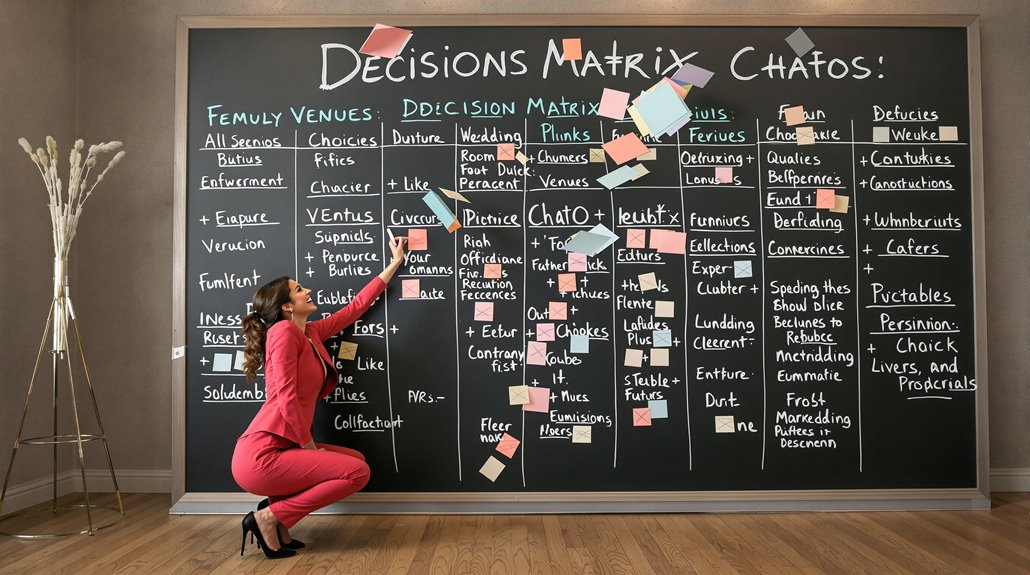
When you’re juggling a wedding plan like a high-stakes project, the decision matrix template is your secret weapon to cut through the chaos. This tool pivots your wedding choices from stress to strategy. Start by defining your criteria—think cost, availability, and quality. Assign weights from 1-5 to prioritize what truly matters. Lay out your options—venues, caterers, florists—and score them on a scale of 1-5 based on performance. Multiply scores by weights, and boom, you’ve got a streamlined, objective decision. This matrix doesn’t mess around; it’s your non-negotiable ally for executing efficient, clear choices. Ready to accelerate your wedding plans? Copy, paste, and let the matrix work its magic. Because, let’s face it, being “bless and stressed” is so last season.
FAQ (quick answers to common edge cases)
Stuck between two options? Remember, clarity beats complexity—use a decision matrix to strategically weigh your priorities and execute with precision. To reduce risk, maintain a streamlined backup plan and ask vendors non-negotiable questions to confirm assumptions—especially if your guest count pivots by 20%.
What if I’m stuck between two options?
Deciding between two budgeting strategies can feel like maneuvering a wedding seating chart—chaotic, but manageable with the right approach. You’re weighing traditional stability against modern flexibility. Imagine combining them: use traditional budgeting for predictable costs like utilities while leveraging zero-based budgeting (ZBB) for dynamic expenses. This hybrid method offers balance, letting you maintain stability without sacrificing responsiveness. Got time? Justify every expense with ZBB for strategic precision. Want simplicity? Traditional budgeting’s incremental adjustments get the job done. Need flexibility? Integrate rolling forecasts to stay agile. Remember, it’s about strategically aligning resources with your goals.
Reality Check: Mixing methods requires clear communication and consistency. Don’t let complexity bog you down—streamline processes with well-defined metrics and a sharp focus on outcomes.
What’s the easiest way to reduce risk with either option?
Balancing the budget for your big day is like a high-stakes dance—one misstep, and chaos can ensue. To reduce risk, start by strategically prioritizing your spending. Forget past patterns; focus on what truly matters to you. Rank services based on their value and impact. This way, you cut the fluff and focus resources where they’re most needed. If revenue takes a nosedive, apply priority-driven cuts to low-value areas, keeping the essentials intact. Embrace a zero-based approach by scrutinizing every expense and aligning it with current goals. This adaptability gets the job done in ever-changing conditions. Avoid the use-it-or-lose-it trap: it’s about results, not just spending limits. Now, create a checklist to track your priorities and budgets.
What should I ask vendors to confirm assumptions?
Wondering how to secure your vendors are on the same page? Start by confirming assumptions with punchy, direct questions. First, clarify timelines—ask vendors to confirm their understanding of deadlines and deliverables. Next, solidify communication preferences. Do they respond best via email, or are they phone-call warriors? Establish a primary contact to streamline the chaos.
Dive into collaboration: are they game for site visits to nail logistics? Ascertain they’re aligned on roles and responsibilities. It’s vital to state non-negotiables upfront—your expectations are a non-wavering lighthouse in the planning storm. Regular check-ins will keep everyone aligned.
Reality Check: Don’t assume vendors read minds. Clear, strategic communication accelerates success. Ready, set, confirm those assumptions. Your wedding execution depends on it!
What changes if my guest count swings by 20%?
When your guest count unexpectedly swings by 20%, you’re not just adjusting a seating chart—you’re recalibrating the entire wedding execution plan. A 20% increase means more mouths to feed, bumping up catering costs considerably. You’ll need a larger venue or more rentals, spiking fixed and variable expenses. Meanwhile, a 20% drop lets you pivot to a more intimate, cost-effective venue, saving on tables, chairs, and centerpieces. Stationery and favors scale with your list—so keep RSVPs precise to dodge budget surprises. Remember, each guest impacts your bottom line, from alcohol to staffing. Strategically manage these shifts using a dynamic budget and checklist. Don’t just react—plan and execute like a pro. Ready to streamline? Let’s move.
What’s the best fallback plan if something goes wrong?
Even the best-laid plans hit a snag, but a rock-solid fallback plan guarantees you pivot with finesse. First, secure two to three indoor venue backups. Think local event spaces or nearby hotels. Create a spreadsheet detailing these options and allocate a contingency budget. Then, tackle transportation. Coordinate with providers for any weather-induced changes and have a backup route ready. Don’t forget a 20% budget buffer for those pesky surprises. Use digital seating charts for instant modifications and assign a reliable friend to manage day-of changes. Secure vendors who thrive under pressure and establish a tight planning timeline. Remember, it’s about executing with precision, not perfection. Next step: nail down those vendor contracts—no negotiations, just results.
Next steps: make the decision + execute the plan
After a whirlwind of options and opinions, it’s time to make the call and kick this wedding plan into high gear. Strategically break down your big day into decision units—think of them as your wedding departments. Each unit should align with modern priorities, not old-school traditions. Here’s how to streamline your process:
Break your wedding into decision units, aligning with modern priorities over traditions.
- Define Objectives: Clearly outline what each unit needs to achieve.
- Rank Importance: Prioritize your decision packages based on contribution to overall goals.
- Resource Allocation: Direct funds to top priorities, cutting unnecessary expenses.
- Justify Every Expense: Demand accountability to keep budgets tight.
- Measure Progress: Track outcomes and refine continuously.
Reality Check: Don’t get lost in past spending habits—focus on what truly matters now. Your wedding should be about smart moves, not just aesthetics.